

Table of
Contents
Page
EXECUTIVE SUMMARY. 3
1......... INTRODUCTION. 5
1.1
Purpose
of the Report 5
1.2
Report
Structure. 5
2......... Project Information. 6
2.1
Background. 6
2.2
Site
Description. 6
2.3
Construction
Programme and Activities. 7
2.4
Project
Organization. 8
2.5
Status
of Environmental Licences, Notification and Permits. 9
3......... Environmental Monitoring Requirements. 10
3.1
Construction
Dust Monitoring. 10
3.2
Construction
Noise Monitoring. 13
3.3
Landscape
and Visual 14
4......... Implementation Status of Environmental Mitigation Measures. 15
5......... Monitoring Results. 16
5.1
Construction
Dust Monitoring. 16
5.2
Regular
Construction Noise Monitoring. 16
5.3
Waste
Management 17
5.4
Landscape
and Visual 17
6......... ENVIRONMENTAL SITE INSPECTION AND AUDIT. 18
7......... Environmental Non-conformance. 19
7.1
Summary
of Monitoring Exceedances. 19
7.2
Summary
of Environmental Non-Compliance. 19
7.3
Summary
of Environmental Complaints. 19
7.4
Summary
of Environmental Summon and Successful Prosecutions. 19
8......... FUTURE KEY ISSUES. 20
8.1
Construction
Programme for the Next Three Months. 20
8.2
Key
Issues for the Coming Month. 20
8.3
Monitoring
Schedule for the Coming Month. 20
9......... ConclusionS AND RECOMMENDATIONS. 21
9.1
Conclusions. 21
9.2
Recommendations. 21
List of
Tables
Table 2.1......... Construction
Activities in the reporting month. 7
Table 2.2......... Contact
Information of Key Personnel 8
Table 2.3......... Status of
Environmental Licenses, Notifications and Permits. 9
Table 3.2 ........ Location of
Construction Dust Monitoring Station. 10
Table 3.3 ........ Noise Monitoring
Parameters, Frequency and Duration. 11
Table 3.5 ........ Noise Monitoring
Stations during Construction Phase. 11
Table 4.1......... Status of Required
Submission under Environmental Permit 12
Table 6.1 ........ Observations and
Recommendations of Site Audit 15
Table 8.1......... Construction
Activities in the coming month. 17
List of
Figures
List of
Appendices
|
Appendix A
|
Construction Programme
|
|
Appendix B
|
Project Organization Structure
|
|
Appendix C
|
Implementation Schedule of Environmental Mitigation
Measures
|
|
Appendix D
|
Summary of Action and Limit Levels
|
|
Appendix E
|
Event and Action Plan
|
|
Appendix F
|
Cumulative Statistics on Complaints, Notification of
Summons and Successful Prosecutions
|
|
Appendix G
|
Monthly Summary Waste Flow Table
|
EXECUTIVE SUMMARY
Central Kowloon Route – Kai Tak West (CKR-KTW;
Contract No. HY/2014/07) (hereafter called “the Project”) covers part of the
construction of the Central Kowloon Route (CKR).
The Project
comprises the follow works:
·
50x30m access shaft with noise enclosure at Ma Tau Kok (MTK);
·
100m long cut-and-cover (C&C) tunnel at MTK;
·
Demolition and re-provisioning of MTK Public Pier;
·
160m long underwater tunnel (UWT) (Stage 1);
·
210m long UWT (Stage 2);
·
60m long C&C tunnel at Kai Tak;
·
130m long depressed road and 200m long underpass at Kai Tak;
·
390m long underground tunnel ventilation audit at Kai Tak;
·
Seawall demolition and construction of new landing steps; and
·
Barging Point enclosure and conveyor system.
All construction works of Contract No.
HY/2014/07 Central Kowloon Route – Kai Tak West (FEP-01/457/2013/C) are
substantially completed in September 2025. The proposal of
termination of the EM&A Programme under
FEP-01/457/2013/C was submitted on 28 November 2025 for approval.
The
EM&A programme commenced on 4 April 2018.The impact EM&A for the
Project includes air quality and noise monitoring. The EM&A monitoring, including both
construction dust monitoring (monitoring station E-A14a) and construction noise
monitoring (monitoring station E-N12a and E-N21a) will be conducted by Contract
No. HY/2023/08 Central Kowloon Route – Remaining Works under EP-457/2013/D from
1 October 2025.
This is the 92nd
monthly EM&A Report presenting the EM&A works carried out during the
period between 1 and 30 November 2025. As informed by the Contractor, major
activities in the reporting period were:
|
Locations
|
Site Activities
|
|
Kai Tak
|
- Defect rectification works at depressed road;
|
|
Ma Tau Kok
|
- Defect
rectification works at Public Transport Interchange
|
|
Kowloon Bay
|
- Block paving outside Kowloon City Public Pier
|
Breaches of Action and Limit Levels for Air Quality
The EM&A monitoring, including both construction
dust monitoring (monitoring station E-A14a) will be conducted by Contract No.
HY/2023/08 Central Kowloon Route – Remaining Works under EP-457/2013/D from 1
October 2025. Details of the corresponding monitoring results, and wind data,
could be referred to Sections 3 of the corresponding Monthly EM&A Report
for Contract No. HY/2023/08.
Breaches of Action and Limit Levels for Noise
Regular Noise
Monitoring
The EM&A monitoring, construction noise monitoring (monitoring
station E-N12a and E-N21a) will be conducted by Contract No. HY/2023/08 Central
Kowloon Route – Remaining Works under EP-457/2013/D from 1 October 2025.
Details of the corresponding monitoring results could be referred to Sections 3
of the corresponding Monthly EM&A Report for Contract No. HY/2023/08.
No exceedance of Action and Limit level of noise was
recorded in the reporting month.
Complaint, Notification of Summons and Successful
Prosecution
One (1) complaint was received in the reporting
month (November 2025). The complaint was investigated
and investigation report was provided in this reporting month (November 2025).
Reporting Changes
No report changes in the
reporting period.
Future Key Issues
Key issues
to be considered in the next month included:
|
Locations
|
Site Activities
|
|
Kai Tak
|
- Defect rectification works at depressed road;
|
|
Ma Tau Kok
|
- Defect rectification works at Public Transport
Interchange
|
|
Kowloon Bay
|
- Nil.
|
Potential environmental
impacts arising from the above construction activities are mainly associated
with construction dust, construction noise, water pollution control, and waste
management.
1
INTRODUCTION
Gammon Construction Limited was commissioned by the Highways Department as the Civil
Contractor for Works Contract HY/2014/07. AECOM Asia Company Limited (AECOM)
was appointed by Gammon Construction Limited as the Environmental Team (ET) to
undertake the Environmental Monitoring and Audit (EM&A) programme
during construction phase of the Project.
1.1
Purpose
of the Report
1.1.1 This is the 92nd monthly
EM&A Report which summaries the impact monitoring results and
audit findings for the Project during the reporting period between 1 and 30
November 2025.
1.2
Report
Structure
1.2.1 This monthly EM&A Report
is organized as follows:
·
Section 1: Introduction
·
Section 2: Project Information
·
Section 3: Environmental Monitoring Requirement
·
Section 4: Implementation Status of Environmental Mitigation Measures
·
Section 5: Monitoring Results
·
Section 6: Environmental Site Inspection and Audit
·
Section 7: Environmental Non-conformance
·
Section 8: Future Key Issues
· Section 9: Conclusions and Recommendations
2
Project Information
2.1
Background
2.1.1 CKR is a dual 3-lane trunk
road across central Kowloon linking the West Kowloon in the west and the Kai
Tak Development (KTD) in the east. The CKR will be about 4.7 km long with an
underground tunnel section of about 3.9 km long, in
particular, there will be an underwater tunnel of about 370 m long in
Kowloon Bay to the north of the To Kwa Wan Typhoon Shelter. It will connect the
West Kowloon Highway at Yau Ma Tei Interchange with the road network at Kowloon
Bay and the future Trunk Road T2 at KTD which will connect to the future Tseung
Kwan O – Lam Tin Tunnel (TKO-LTT) and Cross Bay Link (CBL). CKR, Trunk Road T2
and TKO-LTT will form a strategic highway link, namely Route 6, connecting West
Kowloon and Tseung Kwan O. In addition, 3 ventilation buildings, which will be located in Ya Ma Tei, Ho Man Tin and ex-Kai Tak airport
area, are proposed to ensure acceptable air quality within the tunnel.
2.1.2 The Environmental Impact
Assessment (EIA) Report for Central Kowloon Route (Register No.:
AEIAR-171/2013) was approved on 11 July 2013 under the Environmental Impact
Assessment Ordinance (EIAO). Following the approval of the EIA Report, an
Environmental Permit (EP) for CKR was granted on 9 August 2013 (EP No.: EP-
457/2013) for the construction and
operation. Variation of EP (VEP) was subsequently applied and the latest
EP (EP No. EP-457/2013/D) was issued by the Director of Environmental
Protection (DEP) on 15 June 2021. Further Environmental Permit (EP No.
FEP-01/457/2013/C) for CKR – Kai Tak West was issued on 28 February 2018.
2.1.3 The construction of the CKR had been divided into different sections. This Work Contract
HY/2014/07 – Kai Tak West (KTW) (“The Project”) will include a road which is a
trunk road, including new roads, and major extensions or improvements to
existing roads; a road fully enclosed by decking above and by structure on the
sides for more than 100 m; and reclamation works (including associated dredging
works) more than 1 ha in size and a boundary of which is less than 100 m from
an existing residential area.
2.1.4 The site layout plan of the
Project is shown in Figure 1.1.
2.2
Site
Description
2.2.1 The major construction
activities under this Project include:
(a) construction of approximately 160m long cut-and-cover tunnel and 370m
long underwater tunnel between the tunnel section at Ma Tau Kok and the
depressed road of the CKR within Kai Tak Development;
(b) reconstruction of the seawall at Ma Tau Kok public pier, and the sloping
seawall at the Former Kai Tak Airport Runway;
(c) construction of approximately 125m long depressed road and 200m long
underpass of the CKR within Kai Tak Development;
(d) construction of approximately 360m long underground tunnel ventilation adit of the CKR;
(e) reconstruction of Kowloon City Ferry Pier Public Transport Interchange;
and
(f) other associated works.
2.3
Construction
Programme and Activities
2.3.1 The major construction
activities undertaken in the reporting month are summarized in Table 2.1.
Table 2.1
Construction Activities in the reporting month
|
Locations
|
Site Activities
|
|
Kai Tak
|
- Defect rectification works at depressed road;
|
|
Ma Tau Kok
|
- Defect rectification works at Public Transport
Interchange
|
|
Kowloon Bay
|
- Block paving outside Kowloon City Public Pier
|
2.3.2 The construction programme is presented in Appendix A.
2.4
Project
Organization
2.4.1 The project organization
structure is shown in Appendix B. The key personnel contact names and
numbers for the Project are summarized in Table 2.2.
Table 2.2
Contact Information of Key Personnel
|
Party
|
Role
|
Position
|
Name
|
Telephone
|
Fax
|
|
Arup-Mott MacDonald Joint
Venture
|
Residential Engineer (ER)
|
Engineer’s Representative
|
Mr. Patrick Lo
|
36195901
|
2268
3954
|
|
ERM
|
Independent Environmental
Checker (IEC)
|
Independent Environmental
Checker
|
Ms. Mandy To
|
2271 3113
|
3015 8052
|
|
Gammon
|
Contractor
|
Contracts Manager
|
Mr. Kin Fai Tam
|
2516 8823
|
2516 6260
|
|
Environmental Manager
|
Ms. Michelle Tang
|
9267 8866
|
2516 6260
|
|
AECOM
|
Contractor’s Environmental
Team (ET)
|
ET Leader
|
Mr. Y. W. Fung
|
3856 5681
|
2317 7609
|
2.5
Status
of Environmental Licences, Notification and Permits
2.5.1 Relevant environmental
licenses, permits and/or notifications on environmental protection for this
Project and valid in the reporting month are summarized in Table 2.3.
Table 2.3
Status of Environmental Licenses, Notifications and Permits
|
Permit / License No. /
Notification/ Reference No.
|
Valid Period
|
Status
|
Remarks
|
|
From
|
To
|
|
Further Environmental Permit
|
|
FEP-01/457/2013/C
|
28 Feb 2018
|
End of Project
|
Valid
|
--
|
|
Wastewater Discharge License
|
|
WT00043692-2023
|
1 Apr 2023
|
31 Mar 2028
|
Valid
|
Ma Tau Kok
|
|
WT00043881-2023
|
30 Jun 2023
|
30 Jun 2028
|
Valid
|
Underwater Tunnel
Stage 2
|
|
WT00044013-2023
|
7 May 2025
|
30 Apr 2028
|
Valid
|
Kai Tak and Underwater Tunnel Stage 1
|
|
Construction Noise Permit
|
|
GW-RE0157-25
|
7 Mar 2025
|
6 Sep 2025
|
No further renewal by KTW
|
General Works at Ma Tau Kok
|
|
GW-RE0631-25
|
15 Jun 2025
|
14 Dec 2025
|
Valid
|
General Works at Kai Tak
|
|
GW-RE0418-25
|
30 Apr 2025
|
29 Oct 2025
|
No further renewal by KTW
|
General Works at Stage 1
Underwater Tunnel
|
|
GW-RE0581-25
|
7 Jun 2025
|
6 Nov 2025
|
No further renewal by KTW
|
General Works at Stage 2
Underwater Tunnel
|
|
GW-RE0233-25
|
19 Mar 2025
|
18 Sep 2025
|
No further renewal by KTW
|
Kai Tak Access Road
|
|
Chemical Waste Producer Registration
|
|
5118-247-G2347-47
|
30 Jan 2018
|
End of Project
|
Valid
|
--
|
|
5118-247-G2347-48
|
30 Jan 2018
|
End of Project
|
Valid
|
--
|
|
Marine Dumping Permit
|
|
--
|
--
|
--
|
--
|
--
|
|
Billing Account for Construction Waste Disposal
|
|
7029909
|
22 Jan 2018
|
End of Project
|
Account Active
|
--
|
|
Notification Under Air Pollution Control
(Construction Dust) Regulation
|
|
429442
|
5 Jan 2018
|
End of Project
|
Notified
|
--
|
|
|
3
Environmental Monitoring Requirements
3.1
Construction
Dust Monitoring
Monitoring
Requirements
3.1.1 In accordance with the
approved EM&A Manual, measurement of 24-hour and 1-hour Total Suspended
Particulates (TSP) level at the designated air quality monitoring station is
required. Impact 24-hour TSP monitoring should be carried out
for at least once every 6 days, and 1-hour TSP monitoring should be done
at least 3 times every 6 days while the highest dust impact is expected. The
Action and Limit Levels of the air quality monitoring is
provided in Appendix D.
Monitoring
Equipment
3.1.2
The EM&A monitoring, construction dust monitoring
(monitoring station E-A14a) will be conducted by Contract No. HY/2023/08
Central Kowloon Route – Remaining Works under EP-457/2013/D from 1 October
2025. Details
of the corresponding monitoring equipment could be referred to Sections 3 of
the corresponding Monthly EM&A Report for Contract No. HY/2023/08.
Monitoring Locations
3.1.3 The monitoring station for
construction dust monitoring pertinent to the Project has been identified based
on the approved EM&A Manual for the Project. The location of the
construction dust monitoring station is summarized in Table 3.2 and
shown in Figure 3.1.
Table 3.2
Location of Construction Dust
Monitoring Station
|
Location
|
Monitoring Station
|
Description
|
|
E-A14a [1]
|
Block B of Merit Industrial Centre
|
Rooftop (13/F)
|
Note:
[1] The air monitoring station proposed in the EM&A Manual (i.e.
Wyler Gardens with ID: E-A14) was not available for impact dust monitoring,
therefore impact monitoring was conducted at E-A14a as an alternative which was
agreed by the ER, IEC and EPD.
Monitoring
Methodology
3.1.4 The EM&A monitoring,
construction dust monitoring (monitoring station E-A14a) will be conducted by
Contract No. HY/2023/08 Central Kowloon Route – Remaining Works under
EP-457/2013/D from 1 October 2025. Details of the corresponding monitoring
methodology could be referred to Sections 3 of the corresponding Monthly
EM&A Report for Contract No. HY/2023/08.
Monitoring
Schedule for the Reporting Month
3.1.5 The EM&A monitoring,
construction dust monitoring (monitoring station E-A14a) will be conducted by
Contract No. HY/2023/08 Central Kowloon Route – Remaining Works under
EP-457/2013/D from 1 October 2025. Details of the corresponding monitoring
schedule could be referred to Sections 3 of the corresponding Monthly EM&A
Report for Contract No. HY/2023/08.
3.2 Construction Noise Monitoring
Monitoring
Requirements
3.2.1 In accordance with the
EM&A Manual, impact noise monitoring should be conducted
for at least once a week during the construction phase of the Project. Table
3.3 summarizes the monitoring parameters, frequency and duration of impact
noise monitoring. The Action and Limit Levels of the noise monitoring is provided in Appendix D.
Table 3.3
Noise Monitoring Parameters,
Frequency and Duration
|
Parameter and Duration
|
Frequency
|
|
30-mins measurement at each monitoring
station between 0700 and 1900 on normal weekdays. Leq,
L10 and L90 would be recorded.
|
At least once per
week
|
Monitoring Equipment
3.2.2 The EM&A monitoring,
construction noise monitoring (monitoring station E-N12a and E-N21a) will be
conducted by Contract No. HY/2023/08 Central Kowloon Route – Remaining Works
under EP-457/2013/D from 1 October 2025. Details of the corresponding equipment
could be referred to Sections 3 of the corresponding Monthly EM&A Report
for Contract No. HY/2023/08.
Monitoring
Locations
3.2.3 The monitoring stations for
construction noise monitoring pertinent to the Project have been identified
based on the approved EM&A Manual for the Project. Locations of the
noise monitoring stations are summarized in Table 3.5 and shown in Figure
3.2.
Table 3.5
Noise Monitoring Stations during
Construction Phase
|
Location
|
Monitoring Station
|
Description
|
Measurement
|
|
E-N12a [1]
|
19 Hing Yan Street
|
Rooftop (9/F)
|
Façade
|
|
E-N21a [1]
|
Block B of Merit Industrial Centre
|
Rooftop (13/F)
|
Free field[2]
|
Notes:
[1] The noise
monitoring stations proposed in the EM&A Manual (i.e. Grand Waterfront
Tower 3 with ID: E-N12 and Hang Chien Court Block J with ID: E-N21) were not
available for impact noise monitoring, therefore impact monitoring was
conducted at E-N12a and E-N21a as an alternative which was agreed by the ER, IEC and EPD.
[2] A correction of +3 dB(A) was made to the free field
measurements.
Monitoring Parameters, Frequency and Duration
3.2.4 The EM&A monitoring,
construction noise monitoring (monitoring station E-N12a and E-N21a) will be
conducted by Contract No. HY/2023/08 Central Kowloon Route – Remaining Works
under EP-457/2013/D from 1 October 2025. Details of the corresponding monitoring
parameters, frequency and duration could be referred to Sections 3 of the
corresponding Monthly EM&A Report for Contract No. HY/2023/08.
Monitoring
Methodology
3.2.5 The EM&A monitoring,
construction noise monitoring (monitoring station E-N12a and E-N21a) will be
conducted by Contract No. HY/2023/08 Central Kowloon Route – Remaining Works
under EP-457/2013/D from 1 October 2025. Details of the corresponding monitoring
methodology could be referred to Sections 3 of the corresponding Monthly
EM&A Report for Contract No. HY/2023/08.
Monitoring
Schedule for the Reporting Month
3.2.6 The EM&A monitoring,
construction noise monitoring (monitoring station E-N12a and E-N21a) will be
conducted by Contract No. HY/2023/08 Central Kowloon Route – Remaining Works
under EP-457/2013/D from 1 October 2025. Details of the corresponding monitoring
schedule could be referred to Sections 3 of the corresponding Monthly EM&A
Report for Contract No. HY/2023/08.
3.3 Landscape and Visual
3.3.1
As per the EM&A Manuals, the landscape and visual
mitigation measures shall be implemented and site
inspections should be undertaken once every two weeks during the construction
period. A summary of the implementation status is presented in Section 6.
4
Implementation Status of
Environmental Mitigation Measures
4.1.1
The Contractor has implemented environmental
mitigation measures and requirements as stated in the EIA Reports, the EP and
EM&A Manuals. The implementation status of the environmental mitigation
measures during the reporting period is summarized in Appendix C. Status
of required submissions under the EP during the reporting period is summarised
in Table 4.1.
Table 4.1
Status of Required Submission under Environmental Permit
|
EP Condition
|
Submission
|
Submission Date
|
|
Condition
3.4 of
EP-457/2013/D
and
Condition 3.4 of
FEP-01/457/2013/C
|
Monthly EM&A Report for
October 2025
|
14
November 2025
|
5
Monitoring Results
5.1
Construction
Dust Monitoring
5.1.1
The
EM&A monitoring, including both construction dust monitoring (monitoring
station E-A14a) will be conducted by Contract No. HY/2023/08 Central Kowloon
Route – Remaining Works under EP-457/2013/D from 1 October 2025. Details of the
corresponding monitoring results, and wind data, could be referred to Sections
3 of the corresponding Monthly EM&A Report for Contract No. HY/2023/08.
5.1.2 The event and action plan are
annexed in Appendix E.
5.1.3
Major dust sources during the monitoring included
construction dust and nearby traffic emission.
5.2
Regular
Construction Noise Monitoring
5.2.1
The EM&A monitoring, construction noise monitoring
(monitoring station E-N12a and E-N21a) will be conducted by Contract No.
HY/2023/08 Central Kowloon Route – Remaining Works under EP-457/2013/D from 1
October 2025. Details of the corresponding monitoring results could be referred
to Sections 3 of the corresponding Monthly EM&A Report for Contract No.
HY/2023/08.
5.2.2 No exceedance of Action and
Limit level of noise was recorded in the reporting month.
5.2.3 The event and action plan are
annexed in Appendix E.
5.2.4
Major noise sources during the monitoring included construction noise from
the Project site and nearby traffic noise.
5.3
Waste
Management
5.3.1 C&D materials and wastes
sorting were carried out on site. Receptacles were available for C&D wastes
and general refuse collection.
5.3.2
As advised by
the Contractor, 183 m3 of C&D material were generated
and 183 m3 C&D material was disposed to public fill. No inert C&D were reused in the contract in the
reporting month. 67,650 kg of general refuse was generated and sent
to NENT Landfill in the reporting month. No metal, no paper/cardboard packaging
and no plastics were collected by recycle contractor in the reporting month. No
chemical waste was collected by licensed contractor in the reporting month. No
Type 1, Type 2 and Type 3 Marine sediment were disposed at Confined Marine
Disposal Facility to the East of Sha Chau. The waste flow table is annexed in Appendix
G.
5.3.3 The Contractor is advised to
properly maintain on site C&D materials and wastes collection, sorting and
recording system and maximize reuse / recycle of C&D materials and wastes.
The Contractor is reminded to properly maintain the site tidiness and dispose
of the wastes accumulated on site regularly and properly.
5.3.4 The Contractor is reminded
that chemical waste containers should be properly treated and stored
temporarily in designated chemical waste storage area on site in accordance
with the Code of Practice on the Packaging, Labelling and Storage of Chemical
Wastes.
5.4
Landscape
and Visual
5.4.1 Bi-weekly inspection of the
implementation of landscape and visual mitigation measures was conducted on 12
and 27 November 2025. A summary of the site inspection is provided in Appendix
C. The observations and recommendations made during the site inspections
are presented in Table 6.1.
6
ENVIRONMENTAL SITE INSPECTION AND
AUDIT
6.1.1 Site inspections were carried
out on a weekly basis to monitor the implementation of proper environmental
pollution control and mitigation measures for the Project. A summary of the
mitigation measures implementation schedule is provided in Appendix C.
6.1.2 In the reporting month, 4
site inspections were carried out on 5, 12, 19 and 27 November 2025. Joint
inspections with the IEC, ER, the Contractor and ET were conducted on 27
November 2025. No non-compliance was recorded during the site inspection.
Details of observations recorded during the site inspections are presented in Table 6.1.
Table 6.1
Observations and Recommendations of
Site Audit
|
Parameters
|
Date
|
Observations
and Recommendations
|
Follow-up
|
|
Air
Quality
|
12
November 2025
|
·
Reminder:
·
The contractor was
reminded to provide watering, and cover the
stockpile after used in MTK.
|
The
item was rectified by the Contractor on 19 November 2025.
|
|
12
November 2025
|
·
Reminder:
·
The contractor was
reminded to cover the cement pack after used at ourdoor
area in MTK.
|
The
item was rectified by the Contractor on 19 November 2025.
|
|
19
November 2025
|
·
Reminder:
·
The contractor was
reminded to cover the stockpile at MTK.
|
The
item was rectified by the Contractor on 19 November 2025.
|
|
Noise
|
19
November 2025
|
·
Reminder:
·
The hand held breaker was missing the NEL at MTK.
|
The
item was rectified by the Contractor on 19 November 2025.
|
|
Water
Quality
|
Nil
|
Nil
|
Nil
|
|
Waste/
Chemical Management
|
19
November 2025
|
·
Reminder:
·
The contractor was reminded to maintain house keeping at GWF.
|
The item was rectified by the
Contractor on 19 November 2025.
|
|
19
November 2025
|
·
Reminder:
·
The contractor was advised to provide tarpaulin sheet for the
breaker head to prevent oil leakage to the ground.
|
The item was rectified by the
Contractor on 19 November 2025.
|
|
Landscape
&
Visual
|
Nil
|
Nil
|
Nil
|
|
Permits/
Licenses
|
Nil
|
Nil
|
Nil
|
*The item was under
rectification on last reporting month.
6.1.3
All follow-up
actions requested by Contractor's ET during the site inspection were undertaken
as reported by the Contractor and confirmed in the following weekly site
inspection conducted during the reporting period.
7
Environmental Non-conformance
7.1
Summary
of Monitoring Exceedances
7.1.1 The The
EM&A monitoring, including both construction dust monitoring (monitoring
station E-A14a) and construction noise monitoring (monitoring station E-N12a
and E-N21a) will be conducted by Contract No. HY/2023/08 Central Kowloon Route
– Remaining Works under EP-457/2013/D from 1 October 2025. Details of the corresponding
monitoring parameters, equipment, methodology, monitoring schedule wind data,
results and the established Action and Limit Levels could be referred to
Sections 3 of the corresponding Monthly EM&A Report for Contract No.
HY/2023/08.
7.1.2 No exceedance of Action and
Limit level of noise was recorded in the reporting month.
7.2
Summary of Environmental Non-Compliance
7.2.1
No environmental
non-compliance was recorded in the reporting month.
7.3
Summary
of Environmental Complaints
7.3.1 One (1) complaint was
received in the reporting month (November 2025) and
the investigation was conducted in the current reporting month (November 2025).
Cumulative statistics on environmental complaint is
provided in Appendix F.
7.4
Summary of Environmental Summon and Successful
Prosecutions
7.4.1
No environmental related prosecution or notification
of summons was received in the reporting month. Cumulative statistics on
notification of summons and successful prosecutions is provided in Appendix
F.
8
FUTURE KEY ISSUES
8.1
Construction
Programme for the Next Three Months
8.1.1 The major construction works
in December 2025 is provided in Table 8.1.
All construction works of Contract No. HY/2014/07 Central Kowloon Route – Kai
Tak West (FEP-01/457/2013/C) are substantially completed in September 2025. The
proposal of termination of the EM&A Programme under FEP-01/457/2013/C was submitted on 28 November 2025 for approval.
Table 8.1
Construction Activities in the coming month
|
Locations
|
Site Activities
|
|
Kai Tak
|
- Defect rectification works at depressed road;
|
|
Ma Tau Kok
|
- Defect rectification works at Public Transport
Interchange
|
|
Kowloon Bay
|
- Nil.
|
8.2
Key
Issues for the Coming Month
8.2.1 Potential environmental
impacts arising from the above construction activities are mainly associated
with construction dust, construction noise, and waste management.
8.3
Monitoring
Schedule for the Coming Month
8.3.1
EM&A
monitoring, including both construction dust monitoring (monitoring station
E-A14a) and construction noise monitoring (monitoring station E-N12a and
E-N21a) will be conducted by Contract No. HY/2023/08 Central Kowloon Route –
Remaining Works under EP-457/2013/D from 1 October 2025.
9
ConclusionS AND RECOMMENDATIONS
9.1
Conclusions
9.1.1 The EM&A monitoring,
including both construction dust monitoring (monitoring station E-A14a) and
construction noise monitoring (monitoring station E-N12a and E-N21a) will be
conducted by Contract No. HY/2023/08 Central Kowloon Route – Remaining Works
under EP-457/2013/D from 1 October 2025. Details of the corresponding
monitoring parameters, equipment, methodology, monitoring schedule wind data,
results and the established Action and Limit Levels could be referred to
Sections 3 of the corresponding Monthly EM&A Report for Contract No.
HY/2023/08.
9.1.2 No exceedance of Action and
Limit level of noise was recorded in the reporting month.
9.1.3
4 nos. of environmental site inspections were carried out in November
2025. Recommendations on remedial actions were given by ET and IEC to the
Contractor for the deficiencies identified during the site audit.
9.1.4 One (1) complaint was
received in the reporting month (November 2025) and
the investigation was conducted in the current reporting month (November 2025).
9.1.5 No environmental related
notification of summons and successful prosecution were received in the
reporting month.
9.2 Recommendations
9.2.1 According to the
environmental site inspections performed in the reporting month, the following
recommendations were provided:
Air Quality Impact
· The contractor was reminded
to provide watering, and cover the stockpile after used in MTK.
· The contractor was reminded
to cover the cement pack after used at ourdoor area in MTK.
· The contractor was reminded
to cover the stockpile at MTK.
Construction Noise Impact
· The hand
held breaker was missing the NEL at MTK.
Water Quality Impact
· No specific observation was
identified in the reporting month.
Chemical and Waste Management
· The contractor was reminded
to maintain house keeping at
GWF.
· The contractor was advised to
provide tarpaulin sheet for the breaker head to prevent oil leakage to the
ground.
Landscape & Visual Impact
· No specific observation was
identified in the reporting month.
Permits/licenses
· No specific observation was
identified in the reporting month.
Document control
record
Document
prepared by:
Aurecon Hong Kong Limited
Unit
1608, 16/F, Tower B,
Manulife Financial Centre
223 -231 Wai Yip Street, Kwun Tong, Kowloon, Hong
Kong.
|
T
F
E
W
|
3664 6888
3664 6999
hongkong@aurecongroup.com
www.aurecongroup.com
|
A person using Aurecon documents or data accepts the risk of:
a) Using the documents or data in
electronic form without requesting and checking them for accuracy
b)
Using the documents or data for any purpose not agreed
to in writing by Aurecon.
c)
against the original hard copy version.
|
Document control
|

|
|
Report title
|
Monthly Environmental Monitoring and Audit – Kai Tak Phase 2B
Landscaped Deck – Report No. 13 (Period from 1st to 30th November 2025)
|
|
Document code
|
|
Project number
|
P528199
|
|
File path
|
|
|
Client
|
Build
King – Tung Lee Joint Venture
|
|
Client contact
|
|
Client
reference
|
|
|
Rev
|
Date
|
Revision
details/status
|
Author
|
Reviewer
|
Verifier
(if required)
|
Approver
|
|
0
|
2025-12-04
|
First issue
|
Kisten Ma
|
F.C. Tsang
|
|
F.C. Tsang
|
|
1
|
2025-12-08
|
Second issue
|
Kisten Ma
|
F.C. Tsang
|
|
F.C. Tsang
|
|
|
|
|
|
|
|
|
|
|
|
|
|
|
|
|
|
Current
revision
|
1
|
|
Approval
|
|
Author signature
|

|
Approver signature
|

|
|
Name
|
Kisten Ma
|
Name
|
F.C. Tsang
|
|
Title
|
Senior Consultant
|
Title
|
Environmental
Team Leader
|
Executive Summary
1.1.1
Build King - Tung Lee Joint Venture (“Contractor”)
commenced the construction works of Highway Department (HyD) Central Kowloon Route Contract No.
HY/2023/08 – Central Kowloon Route – Remaining Works at Kai Tak West Area (“The
Project”) on 11
November 2024.
This is the 13th monthly Environmental Monitoring and Audit (EM&A)
report presenting the EM&A works carried out in the Kai Tak West Area
during the period from 1 November 2025 to 30
November 2025.
1.1.2
A summary of major construction
activities informed by the Contractor for the Project during the reporting
period is presented below.
|
Construction Activities Undertaken in Kai Tak West Area
|
|
·
Ramp construction at Kai Tak Phase 2B Landscaped
Deck
·
Drainage system and installation of irrigation pipe
and ducting for cabling works at Kai Tak Phase 2B Landscaped Deck
·
Finishes (floor & wall) at Kai Tak Phase 2B
Landscaped Deck
·
Staircase Construction at Kai Tak Phase 2B
Landscaped Deck
|
Environmental Monitoring and Audit Works
1.1.3
Regular construction air quality monitoring (24-hour TSP and 1-hour TSP)
and noise monitoring activities in the reporting month is summarised in below:
- Construction Air Quality Monitoring (24-hour TSP and 1-hour TSP x 3
times)
-
At Monitoring Station E-A14a on 5, 11, 17, 22 and 28 November 2025
- Construction Noise Monitoring during normal working hours
-
At Monitoring Station E-N12a and EN-21a
on 5, 11, 17, 22 and 28 November 2025
1.1.4
Joint weekly site inspections were conducted by representatives of the
Environmental team (ET), the Contractor and the Engineer on 7, 14, 21 and 28 November 2025. A joint
site inspection with the Independent Environmental Checker (IEC) was undertaken
on 7 and 14 November 2025. Bi-weekly inspection of the
implementation of landscape and visual mitigation measures was conducted by the
ET on 7 and 21 November 2025. Details of the audit findings and implementation status are presented
in Section 7. Details of waste
management are presented in Section 4.
1.1.5
A summary of the non-compliance (exceedance) during the reporting period
is provided below.
-
No Action / Limit Level exceedance for 1-hour
TSP was recorded.
-
No Action / Limit Level exceedance for
24-hour TSP was recorded.
-
No Action / Limit Level exceedance for
construction noise was recorded.
Complaints, Notification of Summons and Successful Prosecution
1.1.6
No environmental related complaints, notification of summons and
successful prosecution were received in the reporting period.
Reporting Changes
1.1.7
There were no reporting changes during the reporting period.
Future Key Issues
1.1.8
A summary of construction activities informed by the Contractor for the
next reporting period are listed below:
|
Construction Activities To be Undertaken in Kai Tak West Area
|
|
·
Finishes (floor & wall) at Kai Tak
Phase 2B Landscaped Deck
·
E&M works at Kai Tak Phase 2B
Landscaped Deck
·
Staircase Construction at Kai Tak
Phase 2B Landscaped Deck
·
Drainage system and installation of irrigation pipe
and ducting for cabling works at Kai Tak Phase 2B Landscaped Deck
|
1
Introduction
1.1
Basic Project Information
1.1.1
Central Kowloon Route (CKR) is a 4.7 km long dual 3-lane trunk road in
Central Kowloon linking Yau Ma Tei Interchange in West Kowloon with the road
network on Kai Tak Development and Kowloon Bay in East Kowloon.
1.1.2
The Central Kowloon Route – Design and Construction Environmental Impact
Assessment Report (Register No.: AEIAR-171/2013) was approved with conditions
by the Environmental Protection Department (EPD) on 11 July 2013. An
Environmental Permit (EP-457/2013) was issued on 9 August 2013. Variations of EP (VEP) was subsequently
applied for and the latest EP (EP-457/2013/D) was issued by EPD on 15 June
2021.
1.1.3
The construction of the CKR had been divided into different sections. Contract No. HY/2023/08 – Central Kowloon Route – Remaining Works covers part of the
construction activities located at Kai Tak West Area and Yau Ma Tei Area under
the EP, including:
- design
and construction of landscaping works at Yau Ma Tei Landscaped Deck, Yau
Ma Tei Rest Gardens, North Tree Park and Kai Tak Phase 2B Landscaped Deck;
- improvement
of a section of Kai Fuk Road of approximately 300 metres in length;
- planting
of compensatory trees; and
- associated
civil works, electrical and mechanical works, road and drainage works,
lighting works and establishment works.
1.1.4
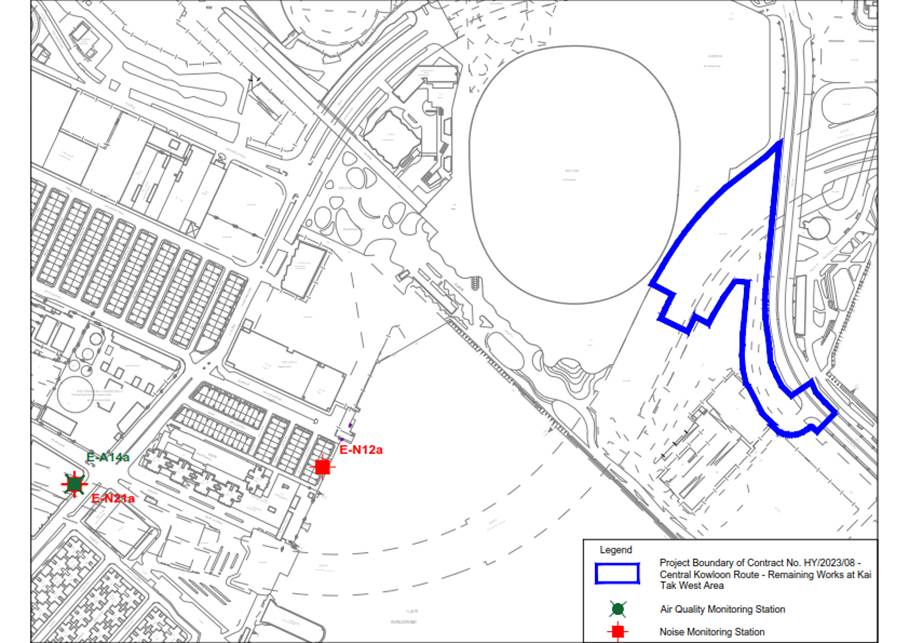
The works site at Kai Tak West Area for the Contract No. HY/2023/08 are
shown in Appendix A.
1.2
Purpose of the Report
1.2.1
This is the 13th monthly Environmental Monitoring and Audit (EM&A) report presenting
the EM&A works carried out for the Project in the Kai Tak West Area during
the period from 1 November 2025 to 30 November 2025.
1.3
Construction Activities Undertaken
During the Reporting Period
1.3.1
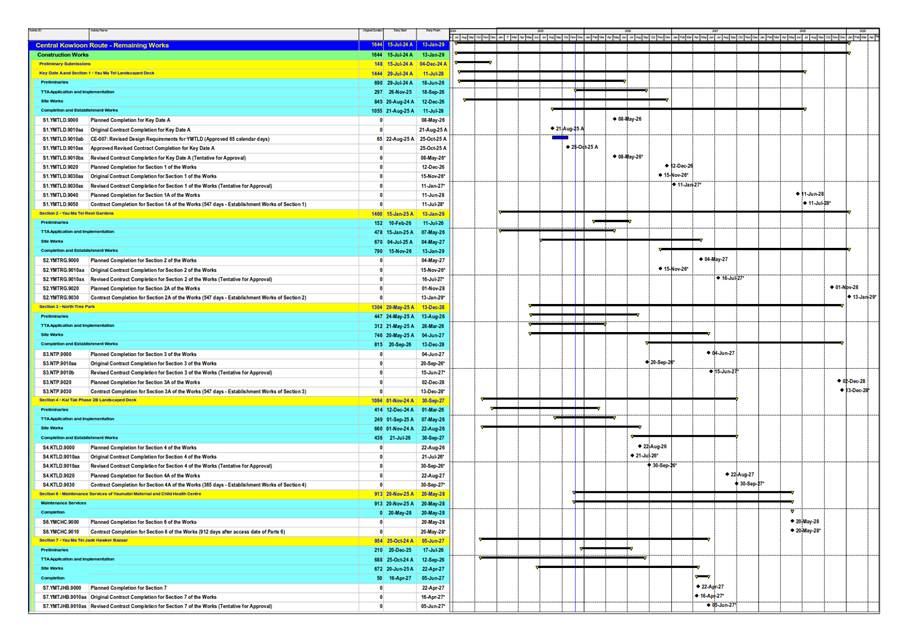
A summary of major construction activities carried out during the
reporting period are presented in Table 1.1. The construction programme is presented in Appendix
B.
Table 1.1 Summary
of Construction Activities during the Reporting Period
|
Construction Activities Undertaken in
Kai Tak West Area
|
Progress
|
|
·
Ramp construction at Kai Tak Phase 2B
Landscaped Deck
|
100%
|
|
·
Drainage system and installation of
irrigation pipe and ducting for cabling works at Kai Tak Phase 2B Landscaped
Deck
|
60%
|
|
·
Finishes (floor & wall) at Kai Tak
Phase 2B Landscaped Deck
|
70%
|
|
·
Staircase Construction at Kai Tak
Phase 2B Landscaped Deck
|
30%
|
1.4
Project Organisation
1.4.1
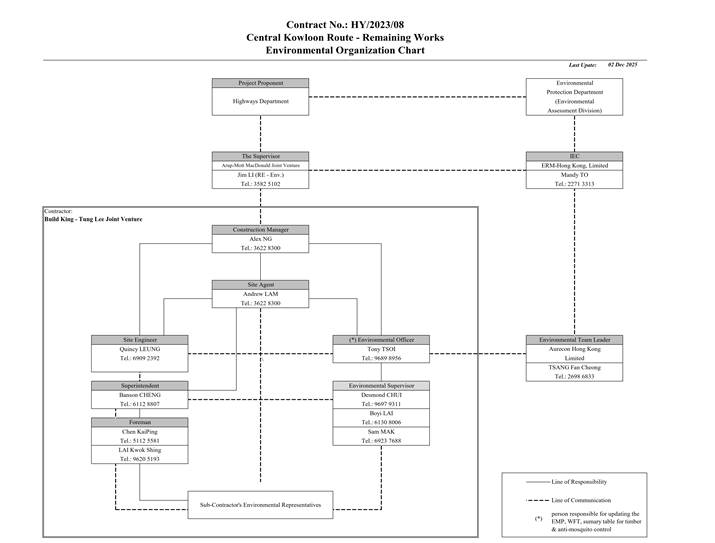
The project organization structure is shown in Appendix C. The
key personnel contact names and numbers for the Project are summarized in Table 1.2.
Table 1.2 Contact Information of Key
Personnel
|
Party
|
Role
|
Position
|
Name
|
Contact No.
|
|
Arup – Mott MacDonald Joint Venture
|
Engineer’s Representative (“ER”)
|
Resident Engineer (Environmental)
|
Ms. Jim Li
|
9120 1157
|
|
ERM – Hong Kong Limited
|
Independent Environmental Checker (“IEC”)
|
IEC
|
Ms. Mandy To
|
2271 3313
|
|
Aurecon Hong Kong Limited
|
Environmental Team (“ET”)
|
ET Leader
|
Mr. F.C. Tsang
|
3664 6801
|
|
Build King – Tung Lee Joint Venture
|
Contractor
|
Environmental Officer
|
Mr. Tony Tsoi
|
9689 8956
|
1.5
Status of
Environmental Licences, Notification and Permit
1.5.1
A summary of the valid permits, licences, and/ or notifications on
environmental protection for this Project is presented in Table 1.3.
Table 1.3 Summary of the Environmental
Licence, Notification, Permit and Documentations
|
Permit/ License/
Notification / Reference No.
|
Valid Period
|
Status
|
Remark
|
|
From
|
To
|
|
|
|
Environmental Permit
|
|
EP-457/2013/D
|
15 June 2021
|
--
|
Valid
|
--
|
|
Wastewater Discharge License
|
|
WT00046473-2025
|
9 May 2025
|
End of Project
|
Valid
|
--
|
|
Notification of Construction Works Under the Air Pollution Control
(Construction Dust Regulation)
|
|
10007346
|
25 July 2024
|
End of Project
|
Notified
|
--
|
|
Chemical Waste Producer Registration
|
|
5213-286-B2767-02
|
19 March 2025
|
--
|
Valid
|
--
|
|
Billing Account for Disposal of Construction Waste
|
|
7051793
|
6 August 2024
|
--
|
Valid
|
--
|
|
Y-Park Membership
|
|
C0280
|
12 August 2024
|
--
|
Valid
|
--
|
|
Construction Noise Permit
|
|
GW-RE1157-25
|
25 September 2025
|
21 March 2026
|
Valid
|
General Activities at Kai Tak Phase 2B Landscaped Deck
|
|
Collection of Public Fill at Public Fill Reception Facility
|
|
TKO137-HY/2023/08-02
|
1 July 2025
|
31 December 2025
|
Valid
|
--
|
|
|
|
|
|
|
3
Air Quality and Noise Monitoring
3.1
Air Quality
Monitoring Requirements
3.1.1
In accordance with the approved EM&A Manual, measurement of 24-hour
and 1-hour Total Suspended Particulates (TSP) level at the designated air
quality monitoring station is required. Impact 24-hour TSP monitoring should be
carried out for at least once every 6 days, and 1-hour TSP monitoring should be
done at least 3 times every 6 days while the highest dust impact is expected.
Monitoring Equipment
3.1.2
24-hour TSP air quality monitoring was performed using High Volume
Sampler (HVS) located at the designated monitoring station. The HVS meets all
the requirements of the EM&A Manual. A portable direct reading dust meter
was used to carry out the 1-hour TSP monitoring.
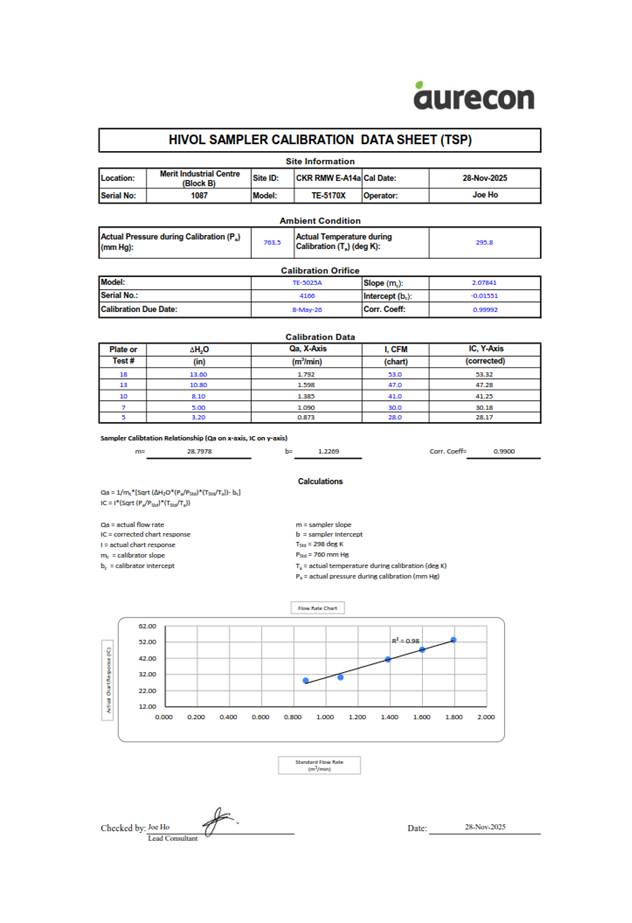
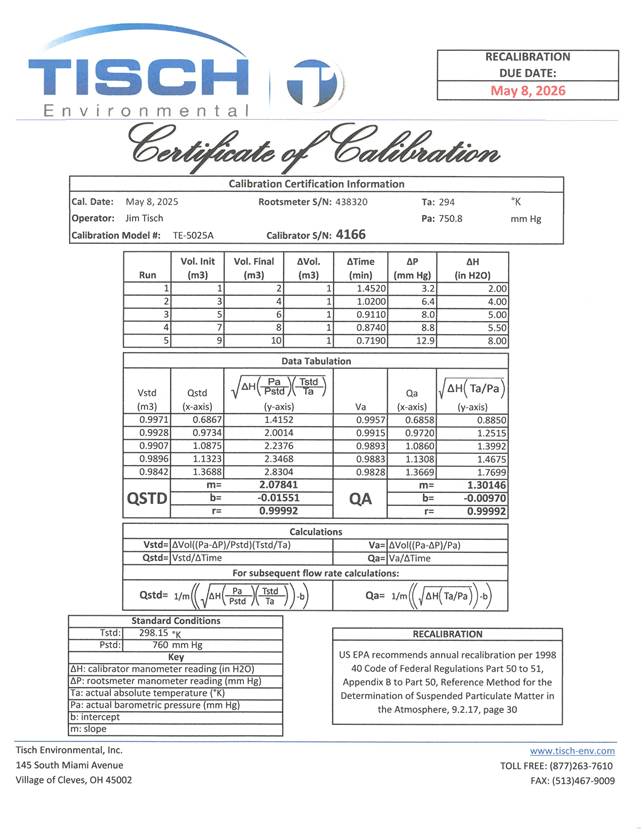
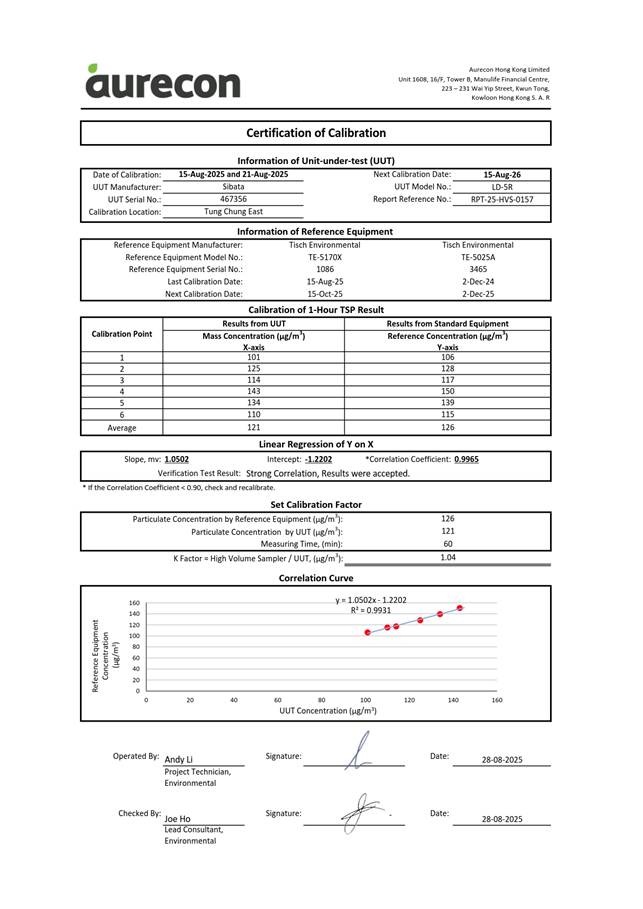
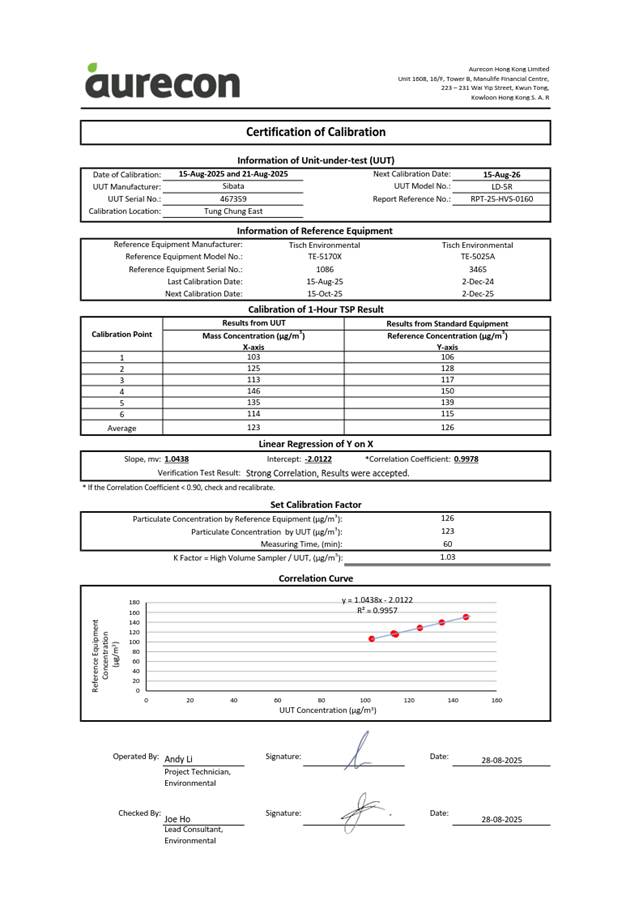
3.1.3
A summary of the equipment that was deployed for the air quality
monitoring is shown in Table 3.1.
Table 3.1 Air
Quality Monitoring Equipment
|
Monitoring Parameter
|
Monitoring Equipment
|
Serial Number
|
Date of calibration
|
|
24-hour TSP
|
High Volume Sampler
(Model No. TE-5170X)
|
1087
|
29 September 2025 & 28 November
2025
|
|
Calibration Kit
(Model No. TE-5025A)
|
4166
|
8 May 2025
|
|
1-hour TSP
|
Digital Dust Indicator
(Model: Sibata LD-5R)
|
467356
|
15 August 2025
|
|
467359
|
15 August 2025
|
Monitoring Locations
3.1.4
The monitoring station for air quality monitoring pertinent to the
Project has been identified based on the approved EM&A Manual for the
Project. The location of the air quality
monitoring station is summarized in Table 3.2 and shown in Appendix G.
Table 3.2 Air
Quality Monitoring Station
|
Location I.D.
|
Monitoring Station
|
Description
|
|
E-A14a
(1)
|
Block B of Merit Industrial Centre
|
Rooftop (13/F)
|
|
Note:
(1) The
air monitoring station proposed in the EM&A Manual (i.e. Wyler Gardens
with ID: E-A14) was not available for impact dust monitoring, therefore
impact monitoring was conducted at E-A14a as an alternative which was agreed
by the ER, IEC and EPD.
|
Monitoring Methodology and QA/QC
3.1.5
24-hour TSP Monitoring
- The HVS was installed in the vicinity of the air sensitive
receivers. The following criteria
were considered in the installation of the HVS as far as practicable: -
-
A horizontal platform with appropriate
support to secure the sampler against gusty wind was provided.
-
Two samplers should not be placed less
than 2m apart from each other.
-
The distance between the HVS and any
obstacles, such as buildings, was at least twice the height that the obstacle
protrudes above the HVS.
-
A minimum of 2 meters separation from
walls, parapets and penthouse for rooftop sampler.
-
A minimum of 2 meters separation from
any supporting structure, measured horizontally is required.
-
No furnace or incinerator flues nearby.
-
Airflow around the sampler was
unrestricted.
-
The sampler was located more than 20
meters from any dripline.
-
Any wire fence and gate, required to
protect the sampler, did not obstruct the monitoring process.
-
Permission was obtained to set up the
samplers and access to the monitoring station.
-
A secured supply of electricity was
obtained to operate the sampler.
- Preparation
of Filter Paper
-
Glass fibre filters, G810 were labelled
and sufficient filters that were clean and without pinholes were selected.
-
All filters were equilibrated in the
conditioning environment for 24 hours before weighing. The conditioning
environment temperature was around 25 °C and not variable by more than ±3 °C;
the relative humidity (RH) was < 50% and not variable by more than ±5%. A
convenient working RH was 40%.
-
All filter papers were prepared and
analysed by Acumen Laboratory and Testing Limited, which is a HOKLAS accredited
laboratory and has comprehensive quality assurance and quality control
programmes.
-
The power supply was checked to ensure
the HVS works properly.
-
The filter holder and the area
surrounding the filter were cleaned.
-
The filter holder was removed by
loosening the four bolts and a new filter, with stamped number upward, on a
supporting screen was aligned carefully.
-
The filter was properly aligned on the
screen so that the gasket formed an airtight seal on the outer edges of the
filter.
-
The swing bolts were fastened to hold
the filter holder down to the frame. The pressure applied was sufficient to
avoid air leakage at the edges.
-
Then the shelter lid was closed and was
secured with the aluminium strip.
-
The HVS was warmed-up for about 5
minutes to establish run-temperature conditions.
-
A new flow rate record sheet was set
into the flow recorder.
-
On site temperature and atmospheric
pressure readings were taken and the flow rate of the HVS was checked and
adjusted at around 1.3 m3/min, and complied with the
range specified in the EM&A Manual (i.e. 0.6-1.7 m3/min).
-
The programmable digital timer was set
for a sampling period of 24 hrs, and the starting time, weather condition and
the filter number were recorded.
-
The initial elapsed time was recorded.
-
At the end of sampling, on site
temperature and atmospheric pressure readings were taken and the final flow
rate of the HVS was checked and recorded.
-
The final elapsed time was recorded.
-
The sampled filter was removed carefully
and folded in half length so that only surfaces with
collected particulate matter were in contact.
-
It was then placed in a clean envelope
and sealed.
-
All monitoring information was recorded
on a standard data sheet.
-
Filters were then sent to Acumen
Laboratory and Testing Limited for analysis.
- Maintenance
and Calibration
-
The HVS and its accessories were
maintained in good working condition, such as replacing motor brushes routinely
and checking electrical wiring to ensure a continuous power supply.
-
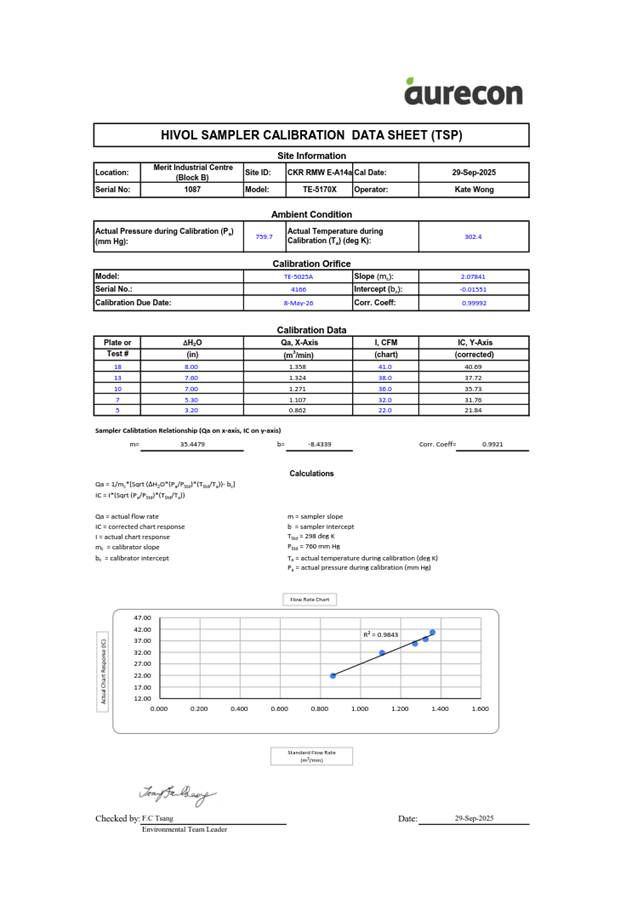
HVSs were calibrated using TE-5025A
Calibration Kit upon installation and thereafter at bi-monthly intervals.
-
Calibration certificate of the TE-5025A
Calibration Kit and the HVSs are provided in Appendix I.
-
The wind speed has been recorded from
Hong Kong Observatory- King’s Park meteorological station, along with portable
wind speed meter stand by as back up when the information is not available from
HKO.
3.1.6
1-hour TSP Monitoring
- The measuring procedures of the 1-hour dust meter are in
accordance with the Manufacturer’s Instruction Manual as follows:
-
Turn the power on.
-
Close the air collecting opening cover.
-
Push the “TIME SETTING” switch to
[BG]
-
Push “START/STOP” switch to perform
background measurement for 6 seconds.
-
Turn the knob at SENSI ADJ position to
insert the light scattering plate.
-
Leave the equipment for 1 minute upon
“SPAN CHECK” is indicated in the display.
-
Push “START/STOP” switch to perform
automatic sensitivity adjustment. This measurement takes 1 minute.
-
Pull out the knob and return it to
MEASURE position.
-
Push the “TIME SETTING” switch the time
set in the display to 3 hours.
-
Lower down the air collection opening
cover.
-
Push “START/STOP” switch to start
measurement.
- Maintenance
and Calibration
-
The 1-hour TSP meter was calibrated at
1-year intervals against a High Volume
Sampler. Calibration certificates of the Laser Dust Monitors
are provided in Appendix I.
Monitoring Schedule for the
Reporting Month
3.1.7
The schedule for impact air quality monitoring in November 2025 is
provided in Appendix H.
Monitoring
Results
3.1.8
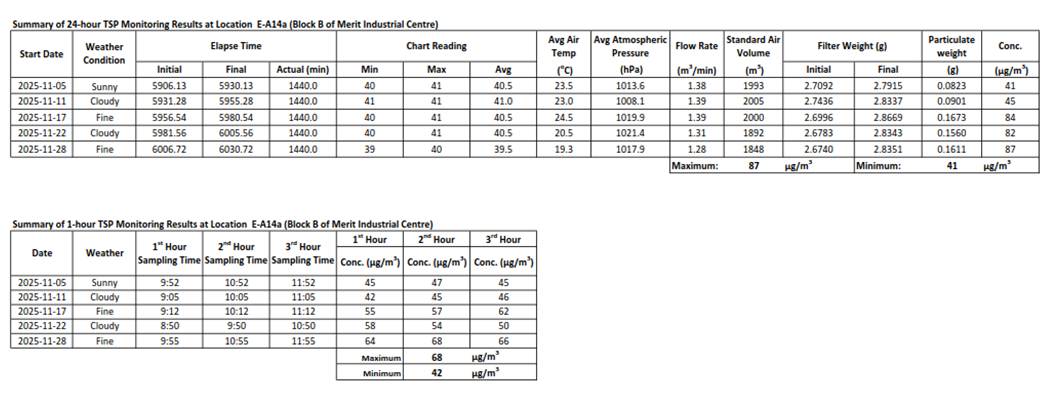
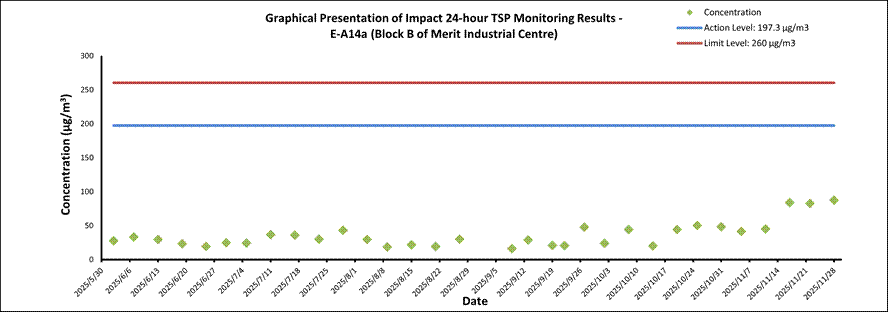
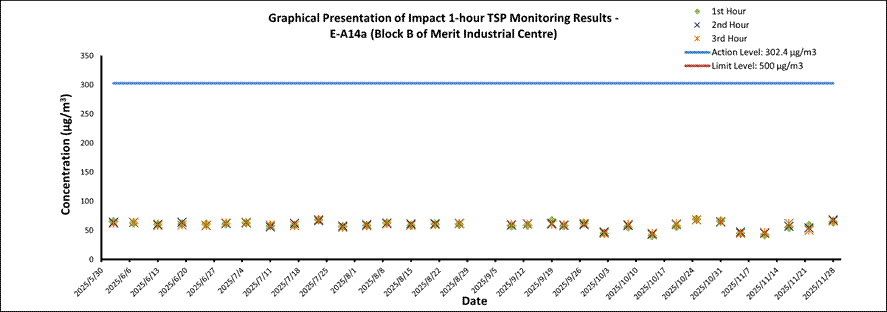
The monitoring results for 24-hour TSP and 1-hour TSP are summarized
in Table 3.3 and Table 3.4 respectively. Detailed air
quality monitoring results and daily extract of meteorological observations are
presented in Appendix J.
Table 3.3 Summary
of 24-hour TSP Monitoring Result in the Reporting Period
|
Location I.D.
|
Range
(μg/m3)
|
Action Level (μg/m3)
|
Limit Level
(μg/m3)
|
|
E-A14a
|
41 – 87
|
197.3
|
260
|
Table 3.4 Summary
of 1-hour TSP Monitoring Result in the Reporting Period
|
Location I.D.
|
Range
(μg/m3)
|
Action Level (μg/m3)
|
Limit Level
(μg/m3)
|
|
E-A14a
|
42 – 68
|
302.4
|
500
|
3.1.9
Major dust sources during the monitoring included construction dust and
nearby traffic emission.
Observations
3.1.10
No Action/ Limit Level exceedance was recorded for all 1-hour TSP and
24-hour TSP monitoring at the monitoring location in the reporting period.
3.1.11
The event and action plan are annexed in Appendix D.
3.1.12
Site audits were carried out on a weekly basis to monitor and audit the
timely implementation of air quality mitigation measures within the site
boundaries of this Project. A summary of
observation during the site audits is shown in Table 7.1 of this report.
3.2
Noise
Monitoring
Requirements
3.2.1
In accordance with the EM&A
Manual, impact noise monitoring should be conducted for at least once a week
during the construction phase of the Project. Table 3.5 summaries the monitoring parameters, frequency and duration of
impact noise monitoring.
Table 3.5 Noise
Monitoring Parameter, Frequency and Duration
|
Parameter and Duration
|
Frequency
|
|
30-mins
measurement at each monitoring station between 0700 and 1900 on normal
weekdays. Leq, L10 and L90
would be recorded.
|
At least once per week
|
Monitoring Equipment
3.2.2
Noise monitoring was performed using sound level meter at each
designated monitoring station. The sound level meters deployed comply
with the International Electrotechnical Commission Publications (IEC) 651:1979
(Type 1) and 804:1985 (Type 1) specifications. Acoustic calibrator was
deployed to check the sound level meters at a known sound pressure level.
A summary of equipment is given in Table 3.6.
Table 3.6 Summary
of Noise Monitoring Equipment
|
Equipment
|
Manufacturer and Model
|
Serial Number
|
Date of calibration
|
|
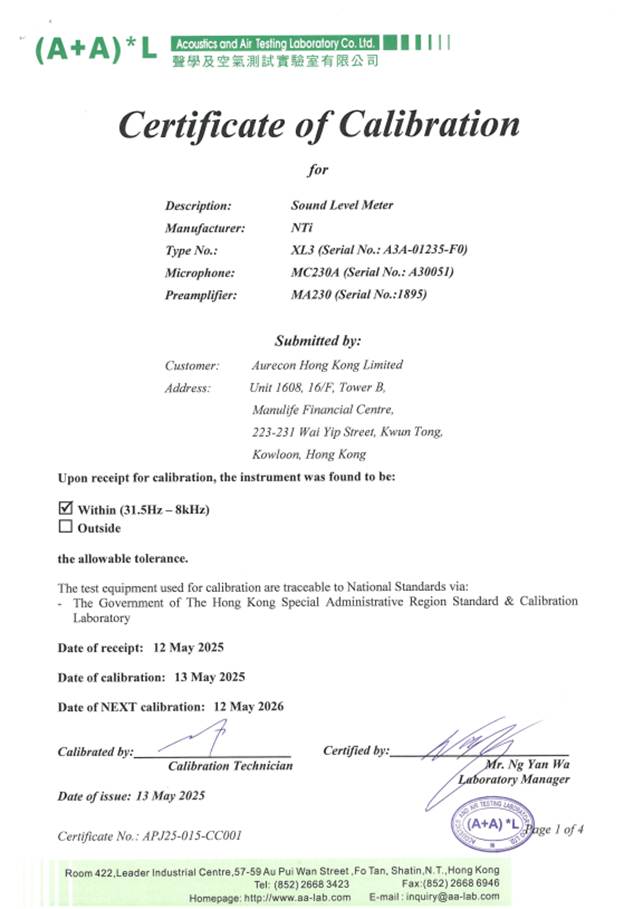
Sound Level
Meter
|
NTi XL3
|
A3A-01230-F0
|
9 June 2026
|
|
A3A-01235-F0
|
12 May 2026
|
|
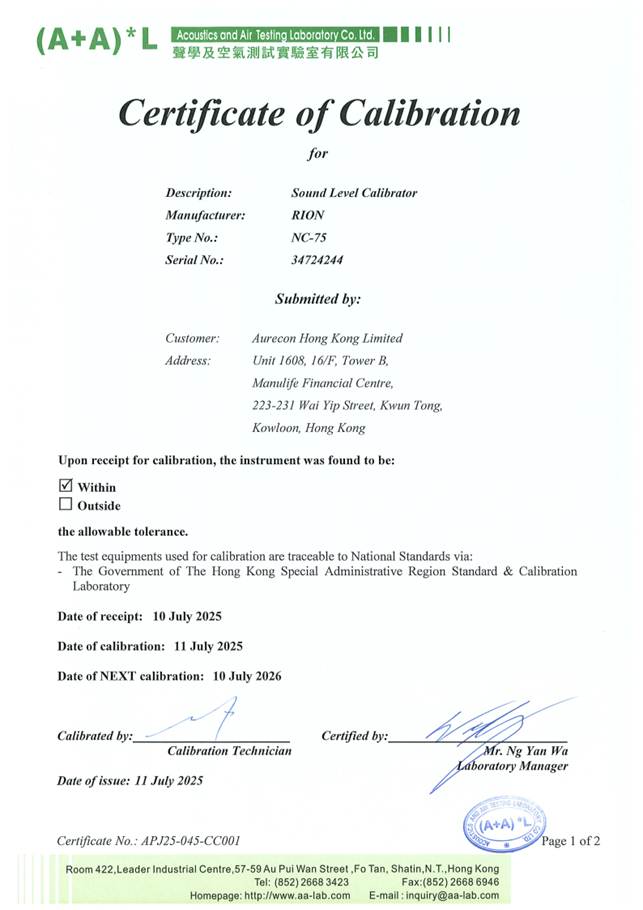
Acoustic
Calibrator
|
RION NC-75
|
A3A-01235-F0
|
12
May 2026
|
Monitoring Locations
3.2.3
The monitoring stations for construction noise monitoring pertinent to
the Project have been identified based on the approved EM&A Manual for the
Project. Locations of the noise monitoring stations are summarized
in Table 3.7 and shown in Appendix
G.
Table 3.7 Noise
Monitoring Station for Construction Phase
|
Location I.D.
|
Monitoring Station
|
Description
|
Measurement
|
|
E-N12a
(1)
|
19 Hing Yan Street
|
Rooftop (9/F)
|
Façade
|
|
E-N21a
|
Block
B of Merit Industrial Centre
|
Rooftop
(13/F)
|
Free-field (2)
|
|
Note:
(1)
The noise monitoring stations proposed
in the EM&A Manual (i.e. Grand Waterfront Tower 3 with ID: E-N12 and Hang
Chien Court Block J with ID: E-N21) were not available for impact noise
monitoring, therefore impact monitoring was conducted at E-N12a and E-N21a as
an alternative which was agreed by the ER, IEC and EPD.
(2) A correction of +3 dB(A) was made to the free-field measurements.
|
Monitoring Methodology and QA/QC
-
The sound level meter was set on a
tripod at a height of 1.2 m above the ground.
-
Façade measurement was made at E-N12a.
-
Free field measurements was made at monitoring location E-N21a. A correction of +3
dB(A) shall be made to the free field measurements.
-
The battery
condition was checked to ensure the correct functioning of the meter.
-
Parameters such as frequency weighting,
the time weighting and the measurement time were set as follows:
§ frequency weighting
§ time weighting: Fast
§ time measurement: Leq(30-minutes)
during non-restricted hours i.e. 0700 – 1900 on normal weekdays.
-
Prior to and after each noise
measurement, the meter was calibrated using the acoustic calibrator for 94
dB(A) at 1000 Hz. If the difference in
the calibration level before and after measurement was more than 1 dB(A), the
measurement would be considered invalid and repeat of noise measurement would
be required after re-calibration or repair of the equipment.
-
During the monitoring period, the Leq, L10 and L90 were
recorded. In addition, site conditions
and noise sources were recorded on a standard record sheet.
-
Noise measurement was paused during
periods of high intrusive noise (e.g. dog barking, helicopter noise) if
possible. Observations were recorded when intrusive noise was unavoidable.
-
Noise monitoring was cancelled in the
presence of fog, rain, wind with a steady speed exceeding 5m/s, or wind with
gusts exceeding 10m/s.
- Maintenance
and Calibration
-
The microphone head
of the sound level meter was cleaned with soft cloth at regular
intervals.
-
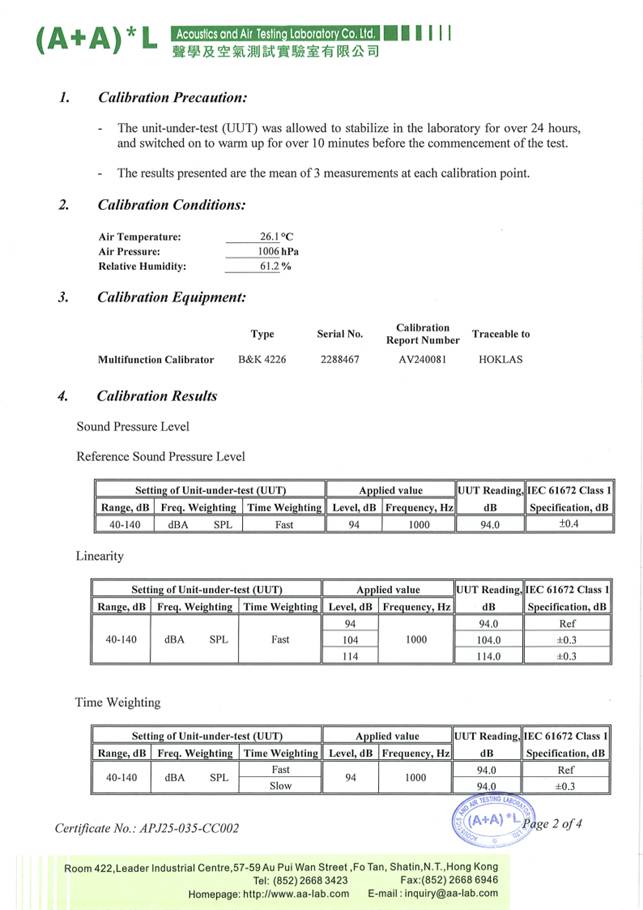
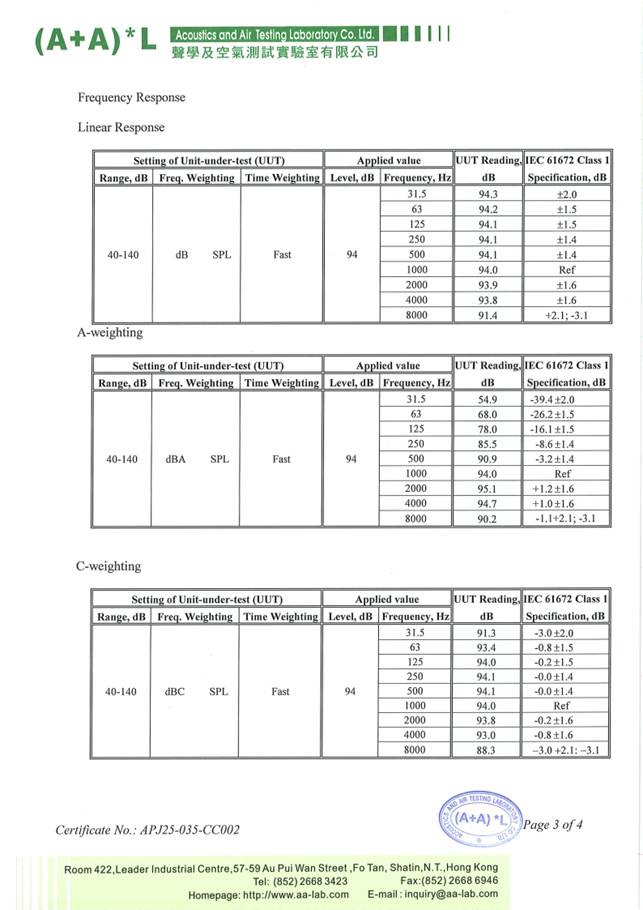
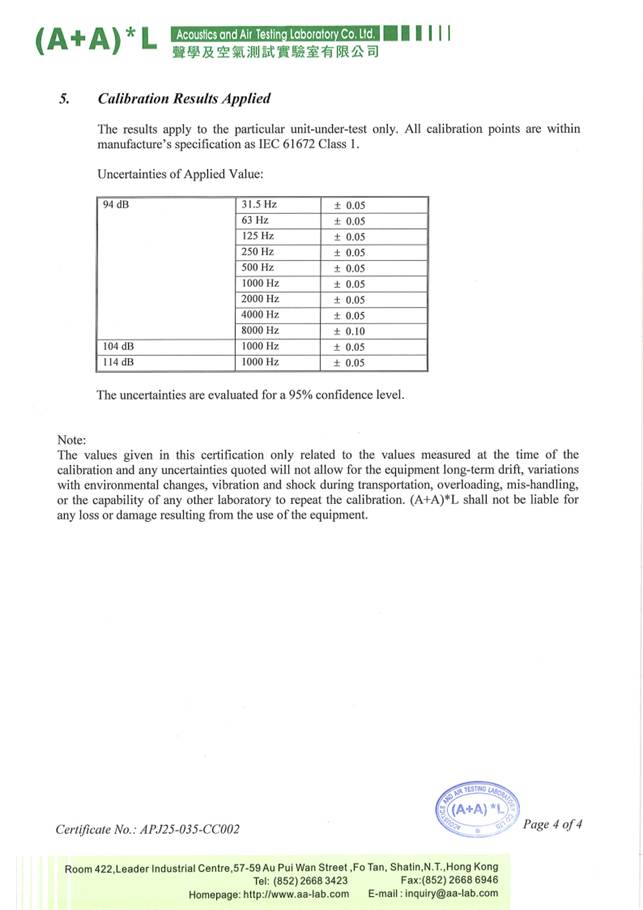
The meter and calibrator were sent to
the supplier or HOKLAS laboratory to check and calibrate at yearly intervals.
-
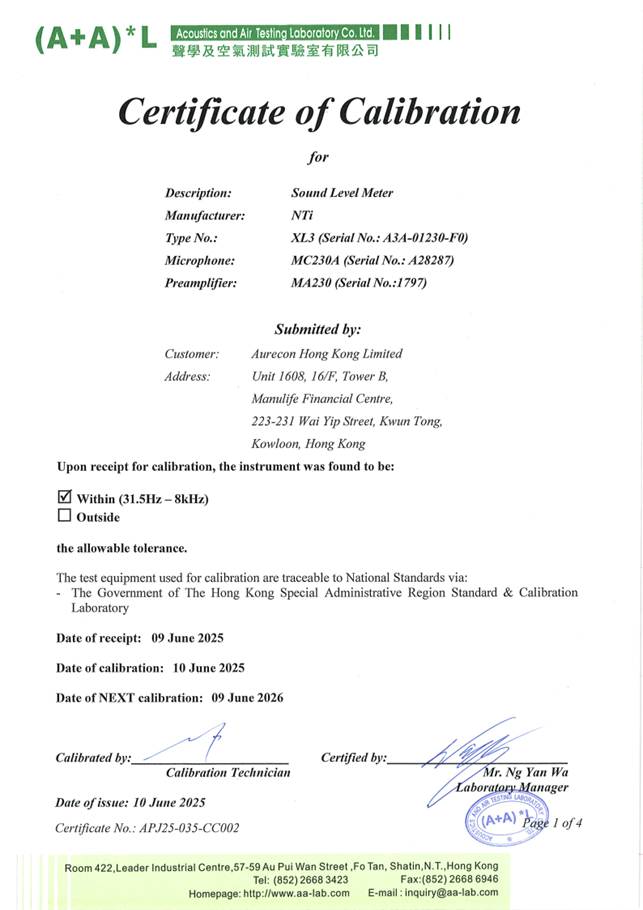
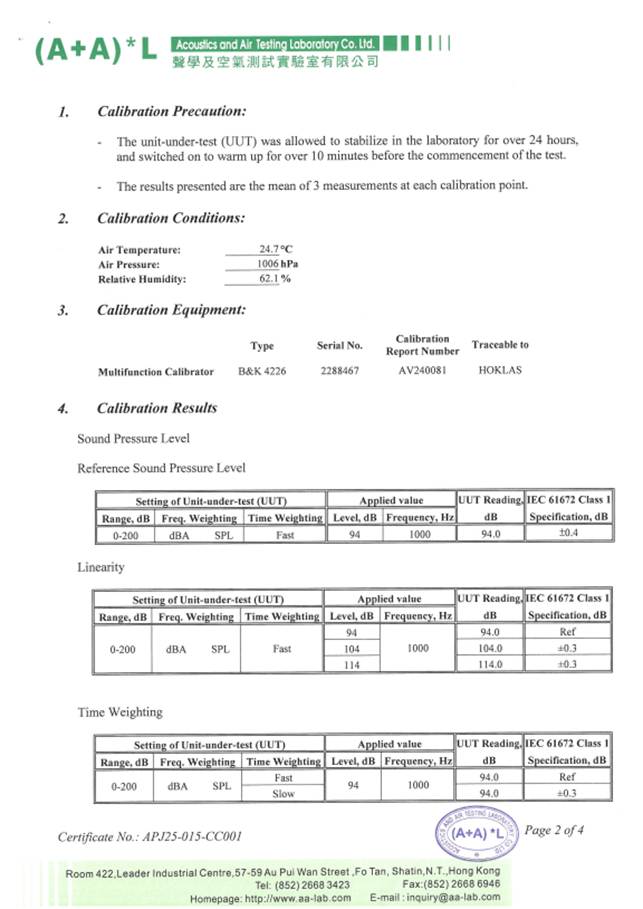
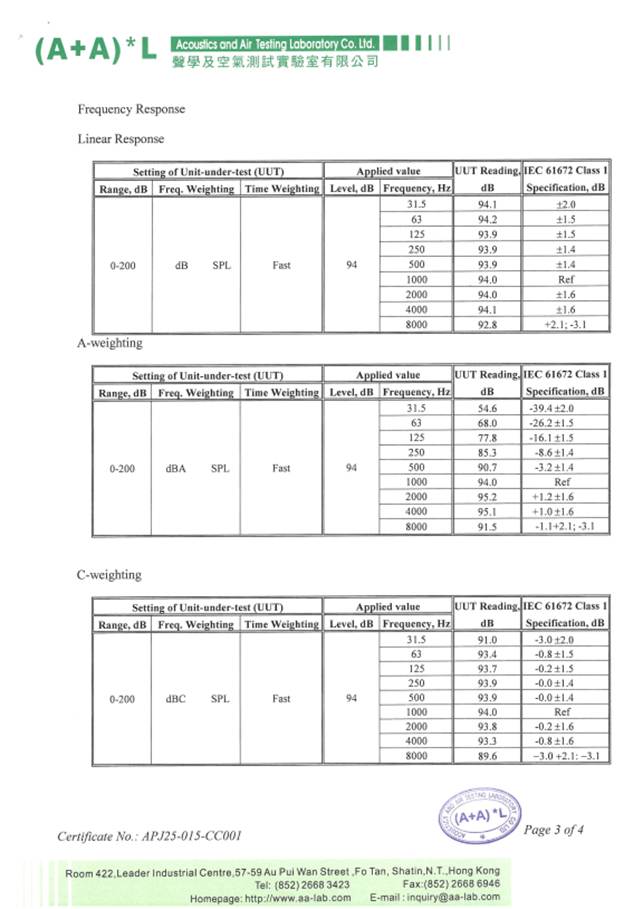
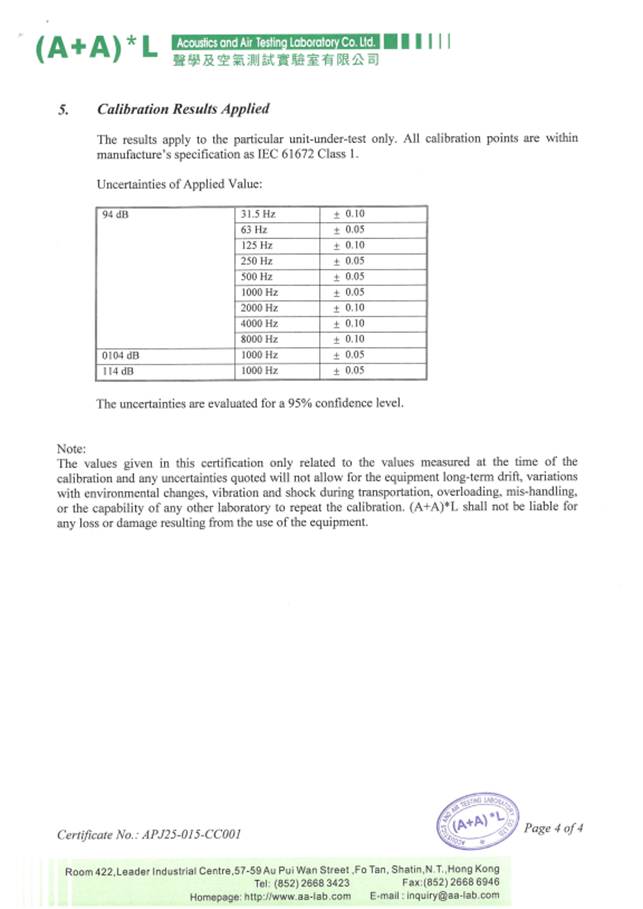
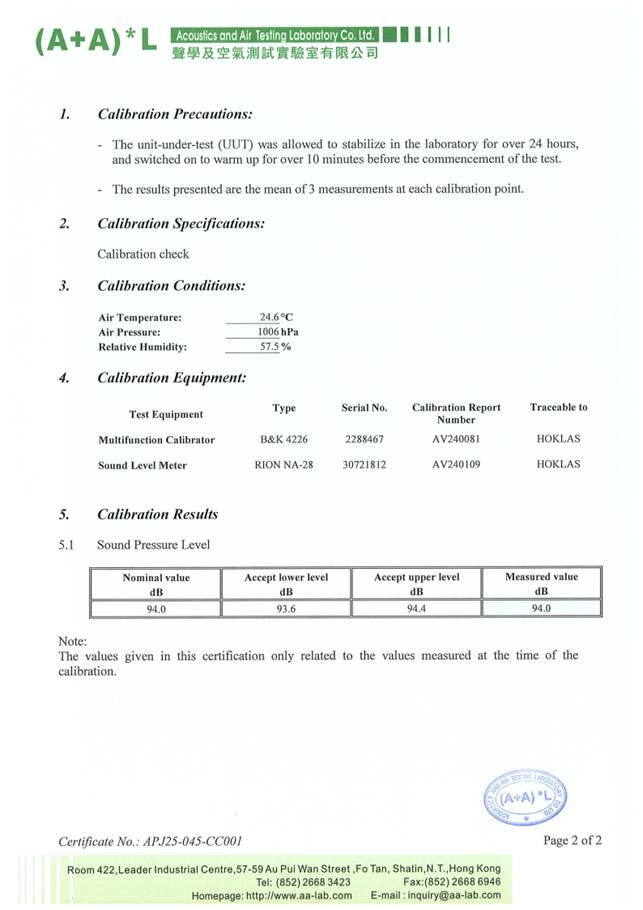
Calibration certificates of
the sound level meters and acoustic calibrators are provided in Appendix
K.
Monitoring Schedule for the
Reporting Month
3.2.4
The schedule for impact air quality monitoring in November 2025 is
provided in Appendix H.
Monitoring Results
3.2.5
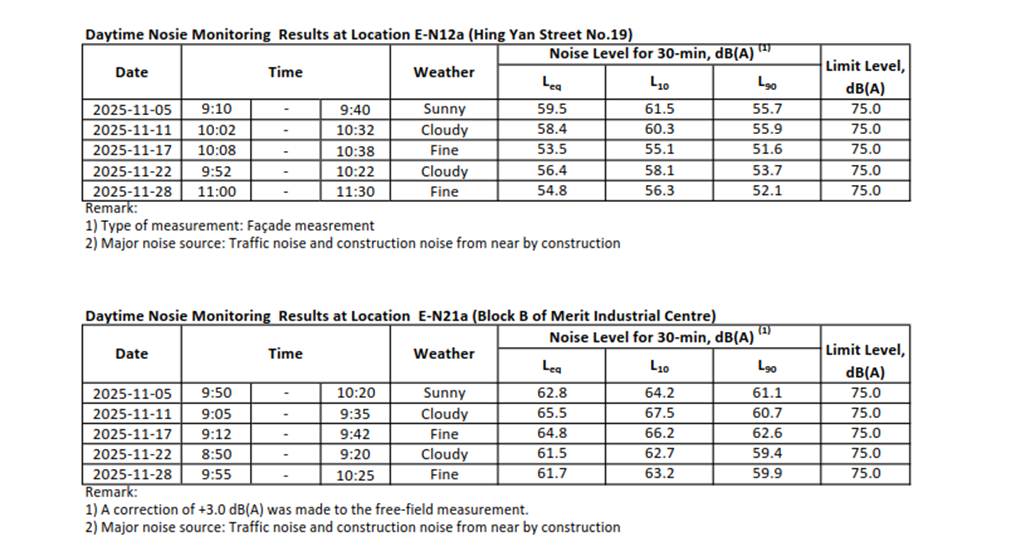
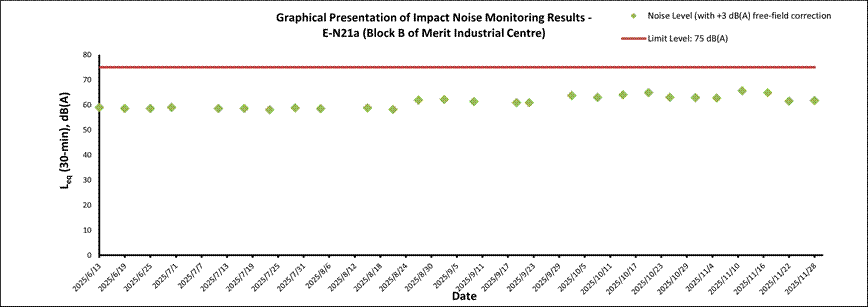
The monitoring results for noise are summarized in Table 3.8 and the monitoring data is
provided in Appendix L.
Table 3.8 Summary
of Construction Noise Monitoring Results in the Reporting Period
|
Location I.D.
|
Range, dB(A), Leq (30 mins)
|
Limit Level, Leq (30 mins)
|
|
E-N12a
|
53.5 – 59.5
|
75.0
|
|
E-N21a
|
61.5 – 65.5 (1)
|
75.0
|
|
Note:
(1) A correction of +3 dB(A) was made to the free-field measurements.
|
3.2.6
Major noise sources during the monitoring included construction noise
from the nearby construction and nearby traffic noise.
Observations
3.2.7
No Action/ Limit Level exceedance was recorded for construction noise monitoring
in the reporting period.
3.2.8
Site audits were carried out on a weekly basis to monitor and audit the
timely implementation of noise mitigation measures within the site boundaries
of this Project. A summary of observations
during the site audits is shown in Table 7.1 of this report.
5
Landscape and Visual
5.1.1
As per the EM&A Manuals, the landscape and visual mitigation
measures shall be implemented, and site inspections should be undertaken once
every two weeks during the construction period.
5.1.2
Bi-weekly inspection of the implementation of landscape and visual
mitigation measures was conducted on 7 and 21 November
2025. The observations and recommendations
made during the site inspections are presented in Table 7.1. A summary of the implementation status is
presented in Appendix F.
6
Summary of Complaints, Notification of Summons
and Prosecutions
6.1.1
The environmental Complaints Handling Procedures is shown below.
|
Complaint
Received via Project Hotline
|
Complaint Received
via 1823 or from other government departments
|
|
|
|
|
|
|
Contractor
notify ER, ET and IEC
|
ER
notify Contractor, ET and IEC
|
|
|
|
|
|
|
Contractor
log complaint and date of receipt onto the complaint database. Contractor, ER
and ET to conduct investigation of complaint
|
|
|
|
|
|
|
If
complaint is considered not valid
|
If
complaint is found valid
|
|
|
|
|
|
|
ET
or ER to reply to the complainant if necessary
|
Contractor to
identify and implement remedial measures in consultation with the IEC, ET and
ER.
|
|
|
|
|
|
|
|
|
The ER, ET and IEC
to review the effectiveness of the Contractor’s remedial measures and the
updated situation; ET to undertake additional monitoring and audit to verify
the situation if necessary and oversee that circumstances leading to the
complaint do not recur. ER to conduct further inspection as necessary.
|
|
|
|
|
|
|
If
the complaint is referred by the EPD, the Contractor to prepare interim
report on the status of the complaint investigation and follow-up actions
stipulated above, including the details of the remedial measures and
additional monitoring identified or already taken, for submission to EPD
within the timeframe assigned by the EPD
|
|
|
|
|
|
The
ET to record the details of the complaint, results of the investigation,
subsequent actions taken to address the complaint and updated situation
including the effectiveness of the remedial measures, supported by regular
and additional monitoring results in the monthly EM&A reports
|
|
|
|
|
|
|
6.1.2
Should non-compliance of the criteria occur, action in accordance with
the Event and Action Plan in Appendix D and Appendix E shall be
carried out.
6.1.3
No exceedance of the Action and Limit Levels of air quality (1-hour TSP
and 24-hour TSP) monitoring and noise monitoring was recorded in the reporting period.
6.1.4
No complaint was received in the reporting period.
6.1.5
No non-compliance was received in the reporting period.
6.1.6
No notification of summons and successful prosecution was received in
the reporting period.
6.1.7
Statistics on complaints, notifications of summons and successful
prosecutions are summarized in Appendix N.
7
EM&A Site Inspection
7.1.1
Site inspections were carried out on a weekly basis to monitor the
implementation of proper environmental pollution control and mitigation
measures under the Contract. In the reporting period, 4 site
inspections were carried out by the representative
of ET, Contractor and Engineer on 7, 14, 21 and
28 November 2025, along with bi-weekly
inspection of the implementation of landscape and visual mitigation measures
conducted on 7 and 21 November 2025.
7.1.2
One joint site inspection with the IEC was also undertaken on 7 and 14 November 2025. Minor deficiencies were observed during weekly site inspection.
Key observations during the site inspections are summarized in Table 7.1.
Table 7.1 Summary
of Site Observation
|
Date
|
Environmental
Observations
|
Follow-up
Status
|
|
7 November 2025
|
Nil.
|
Nil.
|
|
14 November 2025
|
Nil.
|
Nil.
|
|
21 November 2025
|
1.
Drip trays should be provided to
chemicals to avoid leakage.
|
1.
Drip tray was provided for chemicals
near the wastewater treatment system, the concerned chemicals on the
landscape deck was removed.
|
|
2.
Regular watering should be enhanced at
haul road to reduce dust emission.
|
2.
Additional watering at haul road was
applied.
|
|
28 November 2025
|
Nil.
|
Nil.
|
7.1.3
The Contractor has rectified all observation identified during
environmental site inspection.
7.1.4
According to the EIA Study Report, Environmental Permit, contract
documents and EM&A Manual, the mitigation measures detailed in the
documents had been implemented as much as practical during the reporting
period. An updated Implementation Status of Environmental Mitigation Measures
(EMIS) is provided in Appendix F.
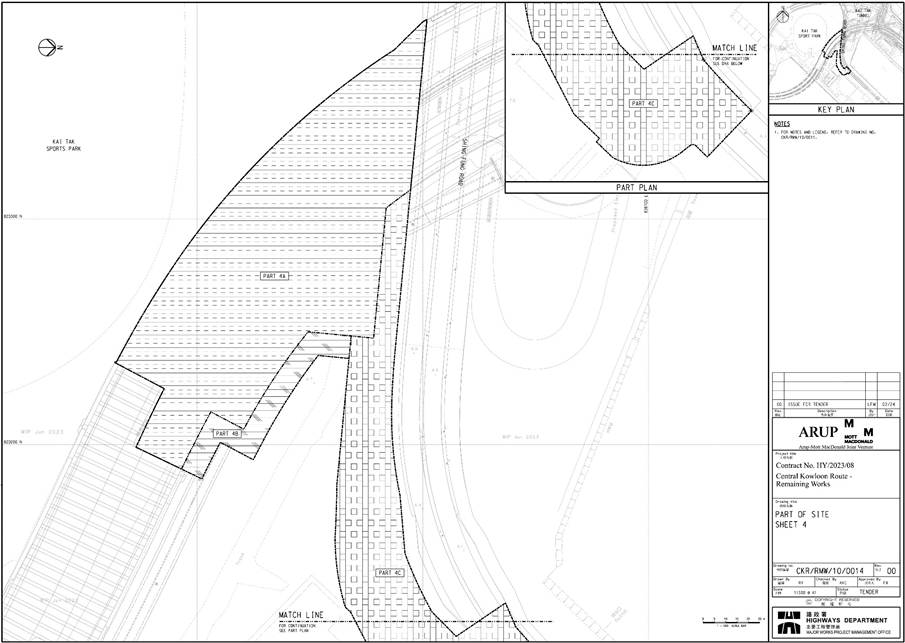
Appendix A
Alignment
and Works Site in Kai Tak West Area for Contract No. HY/2023/08
Kai Tak Phase 2B Landscaped
Deck
|
|
Appendix B
Construction Programme
Appendix C
Project
Organisation Chart
Appendix
D
Event
and Action Plan (EAP) (Air Quality Monitoring)
|
EVENT
|
ACTION
|
|
ENVIRONMENTAL
TEAM (ET)
|
INDEPENDENT
ENVIRONMENTAL CHECKER (IEC)
|
ENGINEER’S
REPRESENTATIVE (ER)
|
CONTRACTOR
|
|
ACTION LEVEL
|
|
Exceedance for one sample
|
1. Identify source, investigate the causes of exceedance and propose
remedial measures;
2. Inform IEC and ER;
3. Repeat measurement to confirm finding;
4. Increase monitoring frequency to daily.
|
1. Check monitoring data
submitted by ET;
2. Check Contractor’s working
method.
|
1. Notify Contractor.
|
1. Rectify any unacceptable practice;
2. Amend working methods if
appropriate.
|
|
Exceedance for two or more consecutive samples
|
1. Identify source;
2. Inform IEC and ER;
3. Advise the ER on the
effectiveness of the proposed remedial measures;
4. Repeat measurements to confirm
findings;
5. Increase monitoring frequency to daily;
6. Discuss with IEC and
Contractor on remedial actions required;
7. If exceedance continues,
arrange meeting with IEC and ER;
8. If exceedance stops, cease
additional monitoring.
|
1. Check monitoring data
submitted by ET;
2. Check Contractor’s working method;
3. Discuss with ET and Contractor
on possible remedial measures;
4. Advise the ET on the
effectiveness of the proposed remedial measures;
5. Supervise implementation of
remedial measures.
|
1. Confirm receipt of
notification of failure in writing;
2. Notify Contractor;
3. Ensure remedial measures
properly implemented.
|
1. Submit proposals for remedial actions
to ER within 3 working days of notification;
2. Implement the agreed proposals;
3. Amend proposal if appropriate.
|
|
LIMIT LEVEL
|
|
Exceedance for one sample
|
1. Identify source, investigate the causes of exceedance and propose
remedial measures;
2. Inform ER, Contractor and EPD;
3. Repeat measurement to confirm finding;
4. Increase monitoring frequency to daily;
5. Assess effectiveness of
Contractor’s remedial actions and keep IEC, EPD and ER informed of the
results.
|
1. Check monitoring data
submitted by ET;
2. Check Contractor’s working method;
3. Discuss with ET and Contractor
on possible remedial measures;
4. Advise the ER on the
effectiveness of the proposed remedial measures;
5. Supervise implementation of
remedial measures.
|
1. Confirm receipt of
notification of failure in writing;
2. Notify Contractor;
3. Ensure remedial measures
properly implemented.
|
1. Take immediate action to avoid
further exceedance;
2. Submit proposals for remedial
actions to IEC within 3 working days of notification;
3. Implement the agreed proposals;
4. Amend proposal if appropriate.
|
|
Exceedance for two or more consecutive samples
|
1. Notify IEC, ER, Contractor and
EPD;
2. Identify source;
3. Repeat measurement to confirm findings;
4. Increase monitoring frequency to daily;
5. Carry out analysis of
Contractor’s working procedures to determine possible mitigation to be implemented;
6. Arrange meeting with IEC and
ER to discuss the remedial actions to be taken;
7. Assess effectiveness of
Contractor’s remedial actions and keep IEC, EPD and ER informed of the results;
8. If exceedance stops, cease additional monitoring.
|
1. Discuss amongst ER, ET, and
Contractor on the potential remedial actions;
2. Review Contractor’s remedial
actions whenever necessary to assure their effectiveness and advise the ER accordingly;
3. Supervise the implementation
of remedial measures.
|
1. Confirm receipt of
notification of failure in writing;
2. Notify Contractor;
3. In consultation with the IEC,
agree with the Contractor on the remedial measures to be implemented;
4. Ensure remedial measures
properly implemented;
5. If exceedance continues,
consider what portion of the work is responsible and instruct the Contractor
to stop that portion of work until the exceedance is abated.
|
1. Take immediate action to avoid
further exceedance;
2. Submit proposals for remedial
actions to IEC within 3 working days of notification;
3. Implement the agreed proposals;
4. Resubmit proposals if problem
still not under control;
5. Stop the relevant portion of
works as determined by the ER until the exceedance is abated.
|
Appendix E
Event
and Action Plan (EAP) (Noise Monitoring)
|
EVENT
|
ACTION
|
|
ENVIRONMENTAL TEAM (ET)
|
INDEPENDENT ENVIRONMENTAL CHECKER (IEC)
|
ENGINEER’S REPRESENTATIVE ER
|
CONTRACTOR
|
|
Action Level
|
1. Identify
source, investigate the causes of exceedance and propose remedial measures;
2. Notify IEC
and Contractor;
3. Report the results of investigation to the
IEC, ER and Contractor;
4. Discuss with the Contractor and formulate
remedial measures;
5. Increase monitoring frequency
to check mitigation effectiveness.
|
1. Review the analysed results submitted by the ET;
2. Review the proposed remedial measures by the
Contractor and advise the ER accordingly;
3. Supervise the implementation of remedial
measures.
|
1. Confirm receipt of notification of failure in
writing;
2. Notify Contractor;
3. Require Contractor to propose
remedial measures for the analysed noise problem;
4. Ensure remedial measures are
properly implemented
|
1. Submit noise mitigation proposals to IEC;
2. Implement noise mitigation
proposals.
|
Appendix F
Environmental Mitigation Implementation Schedule
(EMIS)
Environmental Mitigation Implementation Schedule
|
EIA Ref.
|
EM&A Log Ref.
|
Recommended Mitigation Measures
|
Objectives of the Recommended Measures & Main Concerns to address
|
Implementation Agent
|
Location / Timing
|
Implementation Stage
|
Requirements and/ or standards to be achieved
|
Implementation Status
|
|
Construction
Dust Impact
|
|
S4.3.10
|
D1
|
The
contractor shall follow the procedures and requirements given in the Air
Pollution Control (Construction Dust) Regulation and Air Pollution Control (Non-road Mobile Machinery) (Emission) Regulation.
|
Minimize dust
impact and adverse health effects at the nearby sensitive receivers
|
Contractor
|
All construction sites
|
Construction stage
|
·
APCO
·
To control
the dust impact to meet HKAQO and TM-EIA criteria
|
Implemented.
|
|
S4.3.10
|
D2
|
·
Mitigation
measures in form of regular watering under a good site practice should be
adopted. Watering once per hour on
exposed worksites and haul road should be conducted to achieve dust removal
efficiencies of 91.7%. While the above watering frequencies are to be
followed, the extent of watering may vary depending on actual site conditions
but should be sufficient to maintain an equivalent intensity of no less than
1.3 L/m2 to achieve the dust removal efficiency.
|
Minimize dust
impact at the nearby sensitive receivers
|
Contractor
|
All construction sites
|
Construction stage
|
·
APCO
·
To control
the dust impact to meet HKAQO and TM-EIA criteria
|
Implemented.
|
|
S4.3.10
|
D3
|
·
Proper
watering at exposed spoil should be undertaken throughout the construction
phase;
·
Any excavated
or stockpile of dusty material should be covered entirely by impervious
sheeting or sprayed with water to maintain the entire surface wet and then
removed or backfilled or reinstated where practicable within 24 hours of the
excavation or unloading;
·
Any dusty
materials remaining after a stockpile is removed should be wetted with water
and cleared from the surface of roads;
·
A stockpile
of dusty material should not be extended beyond the pedestrian barriers,
fencing or traffic cones;
·
The load of
dusty materials on a vehicle leaving a construction site should be covered
entirely by impervious sheeting to ensure that the dusty materials do not
leak from the vehicle.
·
Where
practicable, vehicle washing facilities with high pressure water jet should
be provided at every discernible or designated vehicle exit point. The area where vehicle washing takes place
and the road section between the washing facilities and the exit point should
be paved with concrete, bituminous materials or hardcores;
·
When there
are open excavation and reinstatement works, hoarding of not less than 2.4m
high should be provided and properly maintained as far as practicable along
the site boundary with provision for public crossing. Good site practice shall also be adopted by
the Contractor to ensure the conditions of the hoardings are properly
maintained throughout the construction period;
·
The portion
of any road leading only to construction site that is within 30m of a vehicle
entrance or exit should be kept clear of dusty materials;
·
Surfaces
where any pneumatic or power-driven drilling, cutting, polishing or other
mechanical breaking operation takes place should be sprayed with water or a
dust suppression chemical continuously;
·
Any area that
involves demolition activities should be sprayed with water or a dust
suppression chemical immediately prior to, during and immediately after the
activities so as to maintain the entire surface wet;
·
Any skip
hoist for material transport should be totally enclosed by impervious sheeting;
·
Every stock
of more than 20 bags of cement or dry-pulverised fuel ash (PFA) should be
covered entirely by impervious sheeting or placed in an area sheltered on the
top and the 3 sides;
·
Loading,
unloading, transfer, handling or storage of bulk cement or dry PFA should be
carried out in a totally enclosed system or facility, and any vent or exhaust
should be fitted with an effective fabric filter or equivalent air pollution
control system
·
Exposed earth
should be properly treated by compaction, turfing, hydroseeding, vegetation
planting or sealing with latex, vinyl, bitumen, shotcrete or other suitable
surface stabilizer within six months after the last construction activity on
the construction site or part of the construction site where the exposed
earth lies.
|
Minimize dust
impact at the nearby sensitive receivers
|
Contractor
|
All construction sites
|
Construction stage
|
·
APCO
·
To control
the dust impact to meet HKAQO and TM-EIA criteria
|
Implemented, rectified after observation for 1st bullet.
Implemented for the 2nd to 6th bullet.
N/A for other bullets.
|
|
S4.3.10
|
D6
|
Implement
regular dust monitoring under EM&A programme during the construction
stage.
|
Monitoring of dust impact
|
Contractor
|
Selected rep. dust monitoring station
|
Construction stage
|
·
TM-EIA
|
Implemented
|
|
Construction Noise (Airborne)
|
|
S5.4.1
|
N1
|
Implement the following
good site practices:
·
Only
well-maintained plant should be operated on-site, and plant should be
serviced regularly during the construction programme;
·
Machines and
plant (such as trucks, cranes) that may be in intermittent use should be shut
down between work periods or should be throttled down to a minimum;
·
Plant known
to emit noise strongly in one direction, where possible, be orientated so
that the noise is directed away from nearby NSRs;
·
Silencers or
mufflers on construction equipment should be properly fitted and maintained
during the construction works;
·
Mobile plant
should be sited as far away from NSRs as possible and practicable;
·
Material
stockpiles, mobile container site office and other structures should be
effectively utilized, where practicable, to screen noise from on-site
construction activities.
|
Control construction airborne noise
|
Contractor
|
All construction sites
|
Construction stage
|
·
Annex 5,
TM-EIAO
|
Implemented for the 1st, 2nd, 5th
bullets, N/A for other bullets
|
|
S5.4.1
|
N2
|
Install
temporary hoarding located on the site boundaries between noisy construction
activities and NSRs. The conditions of
hoardings shall be properly maintained throughout the construction period.
|
Reduce the construction noise levels at low-level zone of NSRs through
partial screening
|
Contractor
|
All construction sites
|
Construction stage
|
·
Annex 5,
TM-EIAO
|
N/A
|
|
S5.4.1
|
N3
|
Install
movable noise barriers (typical design is wooden framed barrier with a
small-cantilevered on a skid footing with 25mm thick internal sound
absorptive lining), acoustic mat or full enclosure, screen the noisy plants
including air compressors, generators and handheld breakers, etc.
|
Screen the noisy plant items to be used at all construction sites
|
Contractor
|
All construction sites where practicable
|
Construction stage
|
·
Annex 5,
TM-EIAO
|
N/A
|
|
S5.4.1
|
N4
|
Use ‘Quiet plant’
|
Reduce the noise levels of plant items
|
Contractor
|
All construction sites where practicable
|
Construction stage
|
·
Annex 5,
TM-EIAO
|
Implemented
|
|
S5.4.1
|
N5
|
Loading/
unloading activities should be carried out inside the full enclosure of
mucking out points.
|
Reduce the noise levels of loading/ unloading activities
|
Contractor
|
Mucking out locations
|
Construction stage
|
·
Annex 5,
TM-EIAO
|
N/A
|
|
S5.4.1
|
N6
|
Sequencing
operation of construction plants where practicable.
|
Operate sequentially within the same work site to reduce the
construction airborne noise
|
Contractor
|
All construction sites where practicable
|
Construction stage
|
·
Annex 5,
TM-EIAO
|
N/A
|
|
S5.4.1
|
N7
|
Implement a
noise monitoring programme under EM&A programme.
|
Monitor the construction noise levels at the selected representative
locations
|
Contractor
|
Selected rep. noise monitoring station
|
Construction stage
|
·
TM-EIAO
|
Implemented
|
|
Water Quality (Construction Phase)
|
|
S6.9.1.1
|
W1
|
In accordance
with the Practice Note for Professional Persons on Construction Site
Drainage, Environmental Protection Department, 2023 (ProPECC
PN 2/23), construction phase mitigation measures shall include the following:
Construction
Runoff
·
At the start
of site establishment, perimeter cut-off drains to direct off-site water
around the site should be constructed with internal drainage works and
erosion and sedimentation control facilities implemented. Channels (both temporary and permanent
drainage pipes and culverts), earth bunds or sandbag barriers should be
provided on site to direct stormwater to silt removal facilities. The design of the temporary on-site drainage
system will be undertaken by the contractor prior to the commencement of construction;
·
The dikes or
embankments for flood protection should be implemented around the boundaries
of earthwork areas. Temporary ditches
should be provided to facilitate the runoff discharge into an appropriate
watercourse, through a silt/ sediment trap.
The sediment/ silt traps should be incorporated in the permanent
drainage channels to enhance deposition rates;
·
The design of
efficient silt removal facilities should be based on the guidelines in
Appendix A1 of ProPECC PN 2/23, which states that
the retention time for silt/ sand traps should be 5 minutes under maximum
flow conditions. Sizes may vary
depending upon the flow rate, but for a flow rate of 0.1 m3/s a
sedimentation basin of 30 m3 would be required and for a flow rate
of 0.5 m3/s the basin would be 150 m3. The detailed design of the sand/ silt traps
shall be undertaken by the contractor prior to the commencement of construction;
·
All exposed
earth areas should be completed and vegetated as soon as possible after
earthworks have been completed, or alternatively, within 14 days of the
cessation of earthworks where practicable.
Exposed slope surfaces should be covered by tarpaulin or other means;
·
The overall
slope of the site should be kept to a minimum to reduce the erosive potential
of surface water flows, and all traffic areas and access roads protected by
coarse stone ballast. An additional
advantage accruing from the use of crushed stone is the positive traction
gained during prolonged periods of inclement weather and the reduction of
surface sheet flows;
·
All drainage
facilities and erosion and sediment control structures should be regularly
inspected and maintained to ensure proper and efficient
operation at all times and particularly following rainstorms. Deposited silt and grit should be removed
regularly and disposed of by spreading evenly over stable, vegetated areas;
·
Measures
should be taken to minimize the ingress of site drainage into
excavations. If the excavation of
trenches in wet periods is necessary, they should be dug and backfilled in
short sections wherever practicable.
Water pumped out from trenches or foundation excavations should be
discharged into storm drains via silt removal facilities;
·
Open
stockpiles of construction materials (for example, aggregates, sand and fill
material) of more than 50m3 should be covered with tarpaulin or
similar fabric during rainstorms.
Measures should be taken to prevent the washing away of construction
materials, soil, silt or debris into any drainage system;
·
Manholes
should always be adequately covered and temporarily sealed so
as to prevent silt, construction materials or debris being washed into
the drainage system and storm runoff being directed into foul sewers;
·
Precautions
be taken at any time of year when rainstorms are likely, actions to be taken
when a rainstorm is imminent or forecasted, and actions to be taken during or
after rainstorms are summarized in Appendix A2 of ProPECC
PN 2/23. Particular attention should
be paid to the control of silty surface runoff during storm events,
especially for areas located near steep slopes;
·
All vehicles
and plant should be cleaned before leaving a construction site to ensure no
earth, mud, debris and the like is deposited by them on roads. An adequately designed and site wheel
washing facilities should be provided at every construction site exit where
practicable. Wash-water should have
sand and silt settled out and removed at least on a weekly basis to ensure
the continued efficiency of the process.
The section of access road leading to, and exiting from, the wheel
wash bay to the public road should be paved with sufficient backfall toward
the wheel wash bay to prevent vehicle tracking of soil and silty water to
public roads and drains;
·
Oil
interceptors should be provided in the drainage system downstream of any oil/
fuel pollution sources. The oil
interceptors should be emptied and cleaned regularly to prevent the release
of oil and grease into the storm water drainage system after accidental
spillage. A bypass should be provided
for the oil interceptors to prevent flushing during heavy rain;
·
Construction
solid waste, debris and rubbish on site should be collected, handled and
disposed of properly to avoid water quality impacts;
·
All fuel
tanks and storage areas should be provided with locks and sited on sealed
areas, within bunds of a capacity equal to 110% of the storage capacity of
the largest tank to prevent spilled fuel oils from reaching water sensitive
receivers nearby;
·
Adopt best
management practices;
·
All earth
works should be conducted sequentially to limit the amount of construction
runoff generated from exposed areas during the wet season (April to
September) as far as practicable.
|
To minimize water quality impact from the construction site runoff and
general construction activities
|
Contractor
|
All construction sites where practicable
|
Construction stage
|
·
Water
Pollution Control Ordinance
·
ProPECC PN 2/23
·
TM-EIAO
·
TM-DSS
|
Implemented, rectified after reminder for 6th bullet.
Implemented for the 1st, 3rd, 7th to
11th, 13th, 14th to 16th
bullets
N/A for other bullets
|
|
S6.9.1.2
|
W2
|
Tunnelling
Works and Underground
Works
·
Cut-&-cover
tunnelling work
should be conducted sequentially to limit the amount of construction runoff generated
from exposed areas during
the wet season (April to September) as far as practicable.
·
Uncontaminated
discharge should pass through sedimentation tanks prior to off-site discharge;
·
The
wastewater with a high concentration of SS should be treated (e.g. by
sedimentation tanks with sufficient retention time) before discharge. Oil interceptors would also be required to
remove oil, lubricants and grease from the wastewater;
·
Direct
discharge of the bentonite slurry (as a result of
D-wall) is not allowed. It should be
reconditioned and reused wherever practicable. Temporary storage locations (typically a
properly closed warehouse) should be provided on site for any unused
bentonite that needs to be transported away after all the related
construction activities area completed.
The requirements in ProPECC PN 2/23 should
be adhered to in the handling and disposal of bentonite slurries.
|
To minimize construction water quality impact from tunnelling works
|
Contractor
|
All tunnelling portion
|
Construction stage
|
·
Water
Pollution Control Ordinance
·
ProPECC PN 2/23
·
TM-DSS
·
TM-EIAO
|
N/A
|
|
S6.9.1.3
|
W3
|
Sewage
Effluent
·
Portable
chemical toilets and sewage holding tanks are recommended for handling the
construction sewage generated by the workforce. A licensed contractor should be employed to
provide appropriate and adequate portable toilets and be responsible for
appropriate disposal and maintenance.
|
To minimize water quality from sewage effluent
|
Contractor
|
All construction sites where practicable
|
Construction stage
|
·
Water
Pollution Control Ordinance
·
TM-DSS
|
Implemented
|
|
S6.9.1.5
|
W4
|
Groundwater
from Potential Contaminated Area:
·
No direct
discharge of groundwater from contaminated areas should be adopted.
·
A discharge
license under the WPCO through the Regional Office of EPD for
groundwater discharge should be applied. Prior to the excavation works
within these potentially contaminated areas, the groundwater quality should be reviewed
during the process of
discharge license application. The compliance to the Technical Memorandum on
Standards for Effluents Discharged into Drainage on Sewerage Systems, Inland and
Coastal Waters (TM-DSS) and the existence of prohibited substance should be confirmed. If the review
results indicated that the groundwater to be generated from the
excavation works would be contaminated, the contaminated groundwater should be either
properly treated in compliance
with the requirements of the TM-DSS or properly recharged into the
ground.
·
If wastewater
treatment is deployed, the wastewater treatment unit shall deploy
suitable treatment process (e.g. oil interceptor / activated carbon) to
reduce the pollution level to an acceptable standard and remove any
prohibited substances (e.g. TPH) to undetectable range. All treated effluent from
wastewater treatment
plant shall meet the requirements as stated in TM-DSS and should be discharged
into the foul sewers.
·
If
groundwater recharging wells are deployed, recharging wells should be installed as
appropriate for recharging the contaminated
groundwater back into the ground. The recharging wells should be selected
at places where the groundwater quality will not be affected by the recharge operation as
indicated in the Section 2.3
of TM-DSS. The baseline groundwater quality shall be determined prior to
the selection of the recharge wells, and submit a working plan
(including the laboratory analytical results showing the quality of groundwater at
the proposed recharge location(s) as well as the pollutant levels of
groundwater to be recharged) to EPD for agreement. Pollution levels of
groundwater to be recharged shall not be higher than pollutant levels of ambient
groundwater at the recharge well. Prior to recharge, any prohibited
substances such as TPH products should be removed as necessary by installing
the petrol interceptor.
|
To minimize groundwater quality impact from contaminated area
|
Contractor
|
Excavation areas where contamination is found
|
Construction stage
|
·
Water
Pollution Control Ordinance
·
TM-DSS
·
TM-EIAO
|
N/A
|
|
S6.9.1.6
|
W6
|
Accidental
Spillage
In order to prevent accidental spillage of chemicals, the
following is recommended:
·
All the
tanks, containers, storage area should be bunded and the locations should be
locked as far as possible from the sensitive watercourse and stormwater drains;
·
The
Contractor should register as a chemical waste producer if chemical wastes
would be generated. Storage of
chemical waste arising from the construction activities should be stored with
suitable labels and warnings.
Disposal of chemical wastes should be conducted in compliance with the
requirements as stated in the Waste Disposal (Chemical Waste) (General)
Regulation.
|
To minimize water quality impact from accidental spillage
|
Contractor
|
All construction site where practicable
|
Construction stage
|
·
Water
Pollution Control Ordinance
·
ProPECC PN 2/23
·
TM-EIAO
·
TM-DSS
|
Implemented, rectified after observation for 1st bullet.
Implemented for others bullet.
|
|
Waste Management (Construction Waste)
|
|
S7.4.1
|
WM1
|
On-site
sorting of C&D material
·
Geological
assessment should be carried out by competent persons on site during
excavation to identify materials which are not suitable to use as aggregate
in structural concrete (e.g. volcanic rock, Aplite dyke rock, etc.). Volcanic rock and Aplite dyke rock should
be separated at the source sites as far as practicable and stored at
designated stockpile area preventing them from delivering to crushing
facilities. The crushing plant
operator should also be reminded to set up measures to prevent unsuitable
rock from ending up at concrete batching plants and be turned into concrete
for structural use. Details regarding
control measures at source site and crushing facilities should be submitted
by the Contractor for the Engineer to review and agree. In addition, site records should also be
kept for the types of rock materials excavated and the traceability of
delivery will be ensured with the implementation of Trip Ticket System and
enforced by site supervisory staff as stipulated under DEVB TC(W) No. 6/2010
for tracking of the correct delivery to the rock crushing facilities for
processing into aggregates.
Alternative disposal option for the reuse of volcanic rock and Aplite
Dyke rock, etc. should be explored.
|
Separation of unsuitable rock from ending up at concrete batching
plants and be turned into concrete for structural use
|
Contractor
|
All construction sites
|
Construction stage
|
·
DEVB (W) No.
6/2010
|
N/A
|
|
S7.5.1
|
WM2
|
Construction
and Demolition Material
·
Maintain
temporary stockpiles and reuse excavated fill material for backfilling and reinstatement;
·
Carry out
on-site sorting;
·
Make
provisions in the Contract documents to allow and promote the use of recycled
aggregates where appropriate;
·
Adopt
‘selective demolition’ technique to demolish the existing structures and
facilities with a view to recovering broken concrete effectively for
recycling purpose, where possible;
·
Implement a
trip-ticket system for each works contract to ensure that the disposal of
C&D materials is properly documented and verified; and
·
Implement an
enhanced Waste Management Plan similar to ETWBTC
(Works) No. 19/2005 – “Environmental Management on Construction Sites” to
encourage on-site sorting of C&D materials and to minimize their
generation during the course of construction.
|
Good site practice to minimize the waste generation and recycle the
C&D materials as far as practicable so as to
reduce the amount for final disposal
|
Contractor
|
All construction sites
|
Construction stage
|
·
Land
(Miscellaneous Provisions) Ordinance
·
Waste
Disposal Ordinance
·
ETWB TCW No.
19/2005
|
Implemented for the 1st, 2nd, 3rd, 5th,
6th bullets
N/A for other bullets
|
|
S7.5.1
|
WM3
|
C&D Waste
·
Standard
formwork or pre-fabrication should be used as far as practicable in order to minimize the arising of C&D
materials. The use of more durable
formwork or plastic facing for the construction works should be
considered. Use of wooden hoardings
should not be used, as in other projects.
Metal hoarding should be used to enhance the possibility of
recycling. The purchasing of
construction materials will be carefully planned in order
to avoid over ordering and wastage;
·
The
Contractor should recycle as much of the C&D materials as possible
on-site. Public fill and C&D waste should be segregated and stored in
different containers or skips to enhance reuse or recycling of materials and
their proper disposal. Where
practicable, concrete and masonry can be crushed and used as fill. Steel reinforcement bar can be used by
scrap steel mills. Different areas of
the sites should be considered for such segregation and storage.
|
Good site practice to minimize the waste generation and recycle the
C&D materials as far as practicable so as to
reduce the amount for final disposal
|
Contractor
|
All construction sites
|
Construction stage
|
·
Land
(Miscellaneous Provisions) Ordinance
·
Waste
Disposal Ordinance
·
ETWB TCW No.
19/2005
|
N/A
|
|
S7.5.1
|
WM4
|
Excavated
Contaminated Soils
·
Details of
the mitigation measures on handling of the contaminated soil shall be
referred to Section on Land Contamination below.
|
The contaminated soil will be
excavated for on-site reuse
|
Contractor
|
PBH4
|
Prior to
commencement of
construction
works within the contaminated
area
|
·
Practice
Guide (PG) for Investigation and Remediation of Contaminated Land
·
GN/GM for
land contamination
|
N/A
|
|
S7.5.1
|
WM5
|
Land-based
Sediment
·
All
construction plant and equipment shall be designed and maintained to minimize
the risk of silt, sediments, contaminants or other pollutants being
released into the water column or deposited in the locations other than designated location;
·
All vessels
shall be sized such that adequate draft is maintained between vessels and the sea bed at all states of the tide to ensure that undue
turbidity is not generated by turbulence from vessel movement or
propeller wash;
·
Before moving
the vessels which are used for transporting dredged material, excess
material shall be cleaned from the decks and exposed fittings of vessels
and the excess materials shall never
be dumped into the sea except at the approved locations;
·
Adequate
freeboard shall be maintained on barges to ensure that decks are not washed by
wave action.
·
The
Contractors shall monitor all vessels transporting material to ensure that no dumping
outside the approved location takes place. The Contractor shall keep and produce logs
and other records to
demonstrate compliance and that journeys are consistent with
designated locations and copies of such records shall be submitted to the
engineers;
·
The
Contractors shall comply with the conditions in the dumping license.
·
All bottom
dumping vessels (Hopper barges) shall be fitted with tight fittings seals to
their bottom openings to prevent leakage of material;
·
The material
shall be placed into the disposal pit by bottom dumping;
·
Contaminated
marine mud shall be transported by spit barge of not less than 750m3
capacity and capable of rapid opening and discharge at the disposal
site;
·
Discharge
shall be undertaken rapidly, and the hoppers shall be closed immediately.
Material adhering to the sides of the hopper shall not be washed out
of the hopper and the hopper shall remain closed until the barge returns to the
disposal site.
·
For Type 3
special disposal treatment, sealing of contaminant with geosynthetic
containment before dropping designated mud pit would be a possible arrangement. A
geosynthetic containment
method is a method whereby the sediments are sealed in geosynthetic
containers and, the containers would be dropped into the designated contaminated mud pit
where they would be
covered by further mud disposal and later by the mud pit capping at the
disposal site, thereby fulfilling the requirements for fully confined mud
disposal.
|
To control pollution due to marine sediment
|
Contractor
|
Along CKR alignment
|
Construction stage
|
·
ETWB TCW No.
34/2002
|
N/A
|
|
S7.5.1
|
WM6
|
Chemical
Waste
·
Chemical
waste that is produced, as defined by Schedule 1 of the Waste Disposal
(Chemical Waste) (General) Regulation, should be handled in accordance with
the Code of Practice on the Packaging, Labelling and Storage of Chemical Wastes;
·
Containers
used for the storage of chemical wastes should be suitable for the substance
they are holding, resistant to corrosion, maintained in a good condition, and
securely closed, have a capacity of less than 450 L unless the specification
has been approved by EPD, and display a label in English and Chinese in
accordance with instructions prescribed in Schedule 2 of the regulation;
·
The storage
area for chemical wastes should be clearly labelled and used solely for the
storage of chemical waste, enclosed on at least 3 sides, have an impermeable
floor and bunding of sufficient capacity to accommodate 110% of the volume of
the largest container or 20% of the total volume of waste stored in that
area, whichever is the greatest, have adequate ventilation, covered to
prevent rainfall entering, and arranged so that incompatible materials are
adequately separated;
·
Disposal of
chemical waste should be via a licensed waste collector, be to a facility
licensed to receive chemical waste, such as the Chemical Waste Treatment
Centre which also offers a chemical waste collection service and can supply
the necessary storage containers, or be to a reuser
of the waste, under approval from EPD.
|
Control the chemical waste and ensure proper storage, handling and
disposal
|
Contractor
|
All construction sites
|
Construction stage
|
·
Waste
Disposal (Chemical Waste) (General) Regulation
·
Code of
Practice on the Packaging, Labelling and Storage of Chemical Waste
|
Implemented for the 2nd and 3rd bullet.
N/A for other bullet.
|
|
S7.5.1
|
WM7
|
General
Refuse
·
General
refuse generated on-site should be stored in enclosed bins or compaction
units separately from construction and chemical wastes;
·
A reputable
waste collector should be employed by the Contractor to remove general refuse
from the site, separately from construction and chemical wastes, on a daily basis to minimize odour, pest and litter
impacts. Burning of refuse on
construction sites is prohibited by law.
·
Aluminium
cans are often recovered from the waste stream by individual collectors if
they are segregated and made easily accessible. Separate labelled bins for their deposit
should be provided if feasible;
·
Office wastes
can be reduced through the recycling of paper if volumes are large enough to
warrant collection. Participation in a
local collection scheme should be considered by the Contractor.
|
Minimize production of the general refuse and avoid odour, pest and
litter impacts
|
Contractor
|
All construction sites
|
Construction stage
|
·
Waste
Disposal Ordinance
|
Implemented.
|
|
Hazard to Life
|
|
S9.18
|
H8
|
The driver and his assistant should be physically
healthy, experienced and have good safe driving records. The driver should hold a proper driving
licence for the approved transport truck.
Dedicated training programme and regular road safety briefing
sessions/ workshops should be provided to enhance their safe driving attitude
and practice. Smoking should be strictly
prohibited.
|
To reduce the risk during explosives transport
|
Contractor
|
Works areas at which explosives would be used
|
Construction stage
|
-
|
N/A
|
|
S9.18
|
H9
|
Emergency
response plans in case of road accident should be prepared and
implemented. The driver and his
assistant should be familiar with the emergency procedures including
evacuation, and proper communication/ fire-fighting equipment should be
provided to the driver and his assistant.
|
To reduce the risk during explosives transport
|
Contractor
|
Works areas at which explosives would be used
|
Construction stage
|
-
|
N/A
|
|
Landscape & Visual
|
|
S10.10.1
Table 10.11
|
LV3
|
Good Site Management
·
Large
temporary stockpiles of excavated material shall be covered with unobtrusive
sheeting to prevent dust and dirt spreading to adjacent landscape areas and
vegetation, and to create a neat and tidy visual appearance.
·
Construction
plant and building material shall be orderly and carefully stored in order to create a neat and tidy visual appearance.
|
Minimize visual impact
|
Contractor
|
Within Project site
|
Construction stage
|
-
|
Implemented for the 2nd bullet
N/A for another bullet
|
|
S10.10.1 Table 10.11
|
LV4
|
Screen
Hoarding
· Decorative screen hoarding should be erected to
screen the public from the construction area.
It should be designed to be compatible with the existing urban
context.
|
Minimize visual impact
|
Contractor
|
Within Project site
|
Construction stage
|
-
|
N/A
|
|
S10.10.1
Table 10.11
|
LV5
|
Lighting Control during Construction
·
All lighting
in the construction site shall be carefully controlled to minimize light
pollution and night-time glare to nearby residencies and GIC. The Contractor shall consider other
security measures, which shall minimize the visual impacts.
|
Minimize visual impact
|
Contractor
|
Within Project site
|
Construction stage
|
-
|
N/A
|
|
S10.10.1
Table 10.11
|
LV6
|
Erosion Control
·
The potential
for soil erosion shall be reduced by minimizing the extent of vegetation
disturbance on site and by providing a protective cover over newly exposed
soil.
|
Minimize landscape impact
|
Contractor
|
Within Project site
|
Construction stage
|
-
|
N/A
|
|
S10.10.1
Table 10.11
|
LV7
|
Tree Protection & Preservation
·
Carefully
protected during construction. Tree
protection measures will be detailed at the Tree Removal Application stage
and plans submitted to the relevant Government Department for approval in due
course in accordance with ETWB TC No. 3/2006.
|
Minimize landscape and visual impact
|
Contractor
|
Within Project site
|
Construction stage
|
·
‘Guidelines
for Tree Risk Management and Assessment Arrangement on an Area Basis and on a
Tree Basis’, Greening, Landscape and Tree Management (GLTM) Section, DEVB
·
Latest
recommended horticultural practices from GLTM Section, DEVB
|
N/A
|
|
S10.10.1
Table 10.11
|
LV8
|
Tree Transplantation
·
For trees
unavoidably affected by the Project that have to be
removed, where practical transplantation will be chosen as the top priority
method of removal. If this is not
possible or practical compensatory planting will be provided for trees
unavoidably felled (See LV10). For
trees unavoidably affected by the Project works that are transplanted,
transplantation must be carried out in accordance with ETWB TCW 2/2004 and
3/2006.
|
Minimize landscape and visual impact
|
Contractor
|
Within Project site and designated off-site
locations
|
Prior to Construction stage
|
·
ETWB TCW
3/2006
·
Latest
recommended horticultural practices from Greening, Landscape and Tree
Management (GLTM) Section, DEVB
·
ETWB TCW
2/2004
|
N/A
|
|
S10.10.1
Table 10.11
|
LV9
|
Compensatory Planting
·
For trees
unavoidably affected by the Project that have to be
removed, where practical transportation will be chosen as the top priority
method of removal but if this is not possible or practical compensatory
planting will be provided for trees unavoidably felled. All felled trees shall be compensated for
by planting trees to the satisfaction of relevant Government projects. Required numbers and locations of
compensatory trees shall be determined and agreed separately with Government
during the Tree Felling Application process under ETWB TC 3/2006.
·
Compensatory
tree planting may be incorporated into public open spaces and along roadside
amenity areas affected by the construction works and therefore be part of the
bigger wider planting plans. Onsite
compensation planting is preferred but, if necessary, additional receptor
sites outside the Works Area shall be agreed separately with the Government
during the Tree Felling Application process.
|
Minimize visual impact and also
enhance landscape
|
Contractor
|
Within Project site
|
Construction stage
|
·
ETWB TCW
3/2006
·
Latest
recommended horticultural practices from Greening, Landscape and Tree
Management (GLTM) Section, DEVB
·
ETWB TCW
2/2004
|
N/A
|
|
S10.10.1
Table
10.11
|
LV10
|
Screen Planting
·
Tall
screen/buffer trees, shrubs and climbers should be planted, in so far as is
possible, to soften and screen proposed structures such as roads and central
strip, vertical edges and buildings and to enhance streetscape greening
effect where appropriate. Indiscriminate use of trees for screening must be
avoided and the principle of ‘right tree for the right place’ must be
followed. This detail will be provided at the Detailed Design stage. This
measure may additionally form part of the compensatory planting and will
improve and create a pleasant pedestrian environment.
|
Minimize visual impact and
also enhance landscape.
|
Contractor
|
Within
Project Site
|
Construction
Phase
|
·
Guidelines on
Greening of Noise Barriers, issued April 2012, GLTMS, DevB
·
ETWB TCW
2/2004
|
N/A
|
|
S10.10.1
Table
10.11
|
LV12
|
Reinstatement
·
All works
areas, excavated areas and disturbed areas for tunnel construction and
temporary road diversion or any other proposed works shall be reinstated to
former conditions or better, with reasonable landscape treatment and to the
satisfaction of the relevant Government departments. (Specific mitigation for
disturbance to public open space is detailed separately under LV14.)
|
Minimize landscape impact
|
Contractor
|
Within
Project Site
|
Construction
Phase
|
·
N/A
|
N/A
|
|
Cultural Heritage Impact
(Construction Phase)
|
|
S11.4.4
|
CH1
|
The contractor should be alerted during the construction on the
possibility of locating archaeological remains and as a precautionary
measure, AMO shall be informed immediately in case of discovery of
antiquities or supposed antiquities in the subject sites.
|
To preserve any cultural heritage items which may be removed and
damaged by the excavation
|
Contractor
|
During construction works for cut and cover tunnels
|
Construction stage
|
·
AMOs
requirements
|
N/A
|
|
EM&A Project
|
|
S13.2
|
EM1
|
An Independent Environmental Checker needs to be employed as per the
EM&A Manual
|
Control EM&A Performance
|
Highways Department
|
All construction sites
|
Construction stage
|
·
EIAO Guidance
Note No. 4/2010
·
TM-EIAO
|
Implemented
|
|
S13.2-13.4
|
EM2
|
·
An
Environmental Team needs to be employed as per the EM&A Manual;
·
Prepare a
systematic Environmental Management Plan to ensure effective implementation
of the mitigation measures;
·
An
environmental impact monitoring needs to be implemented by the Environmental
Team to ensure all the requirements given in the EM&A Manual are fully
complied with.
|
Perform environmental monitoring & auditing
|
Highways Department/ Contractor
|
All construction sites
|
Construction stage
|
·
EIAO Guidance
Note No. 4/2010
·
TM-EIAO
|
Implemented
|
|
|
|
|
|
|
|
|
|
|
Appendix
G
Location
Plan of Air Quality and Noise Monitoring Station
Appendix
H
Monitoring
Schedule for the Reporting Month and Coming Month
Monitoring
Schedule for the Reporting Month (November 2025)
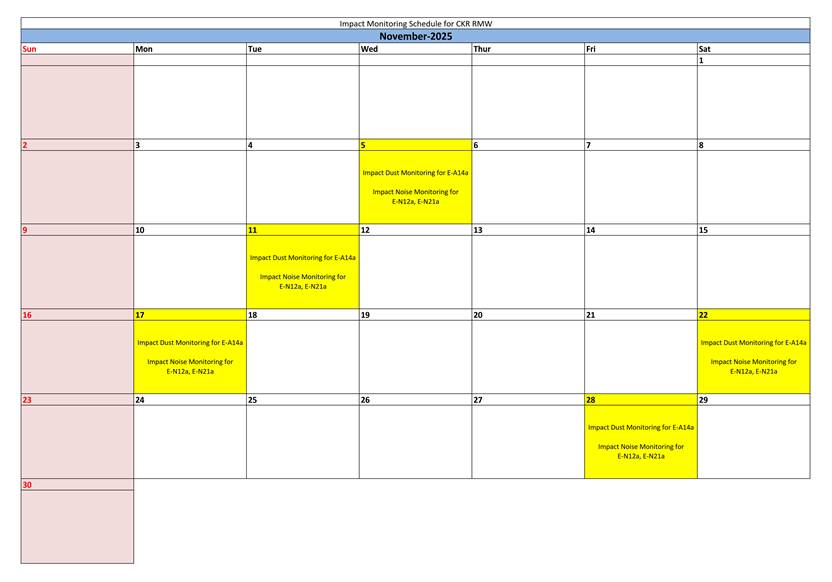
Monitoring
Schedule for the Coming Month (December 2025)
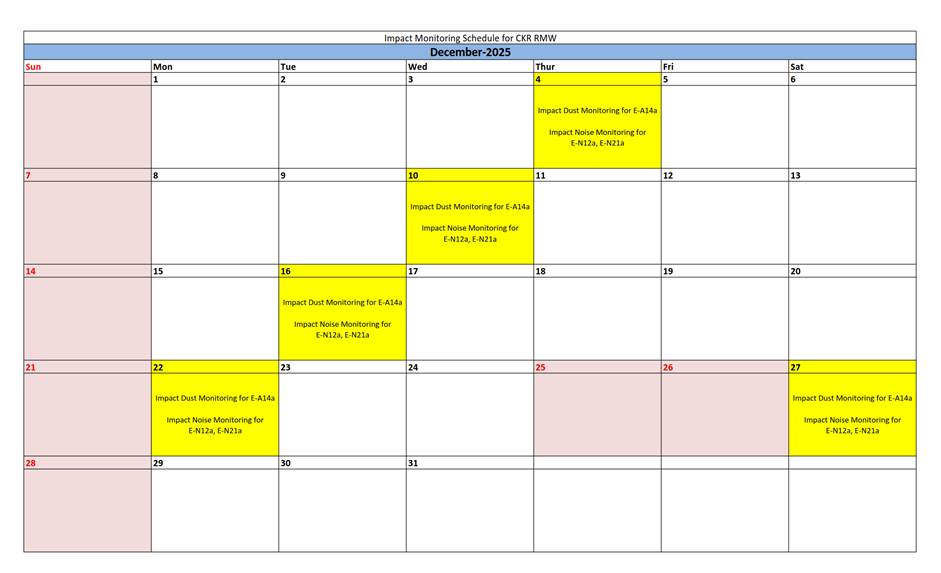
Appendix
I
Calibration
Certificates for Air Quality Monitoring Equipment
Appendix
J
Air
Quality Monitoring Results and their Graphical Presentations
Data of Wind Direction Extracted from Kai Tak
Wind Station of the Hong Kong Observatory
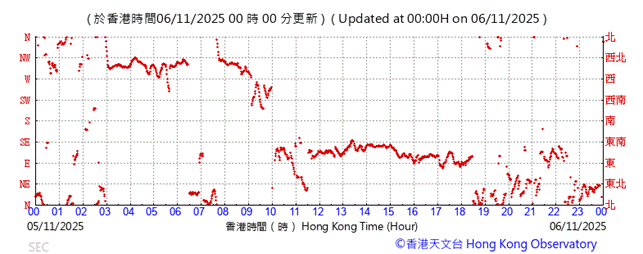
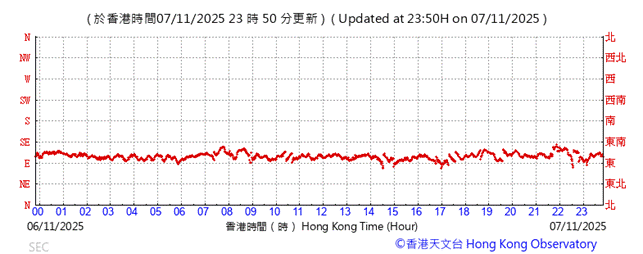
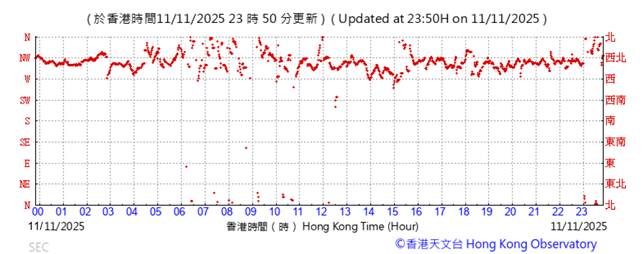
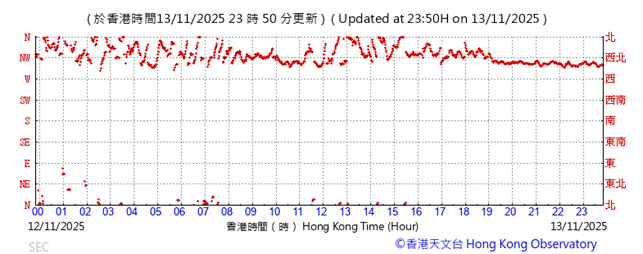
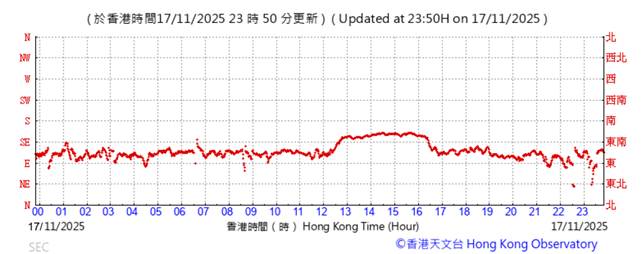


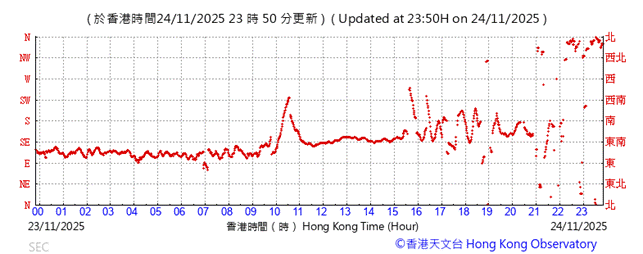
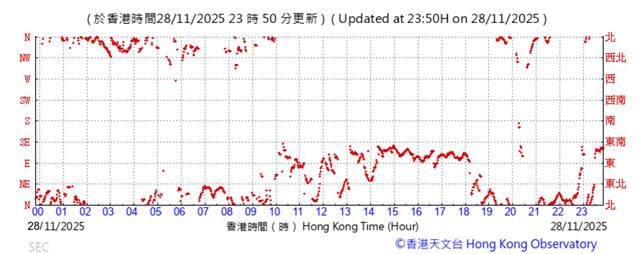
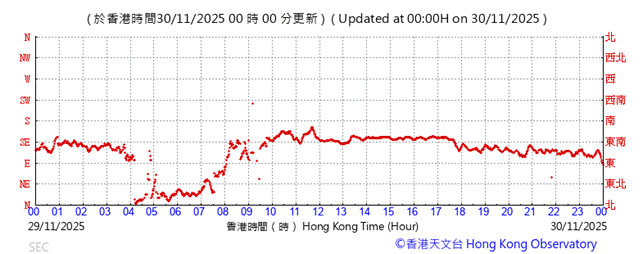
Data of Wind Speed Extracted from Kai Tak
Wind Station of the Hong Kong Observatory
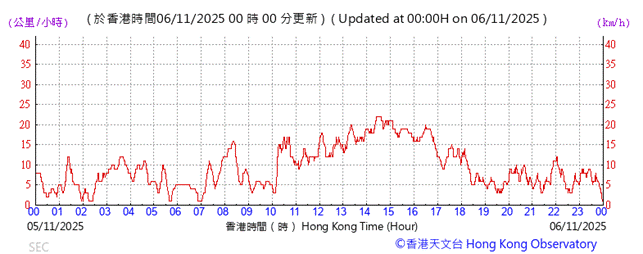
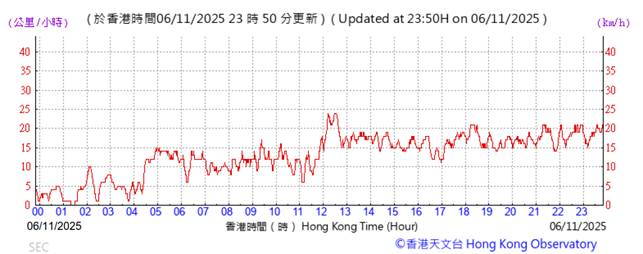
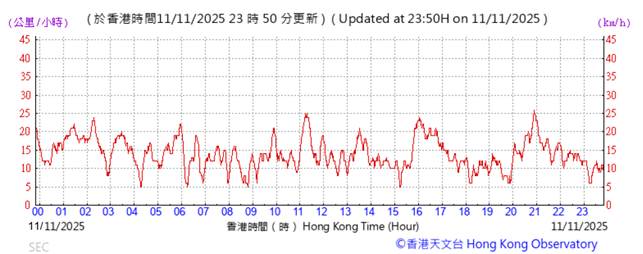

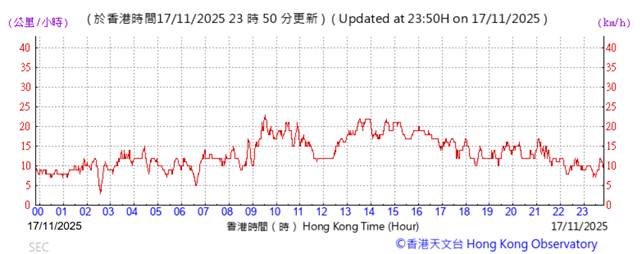
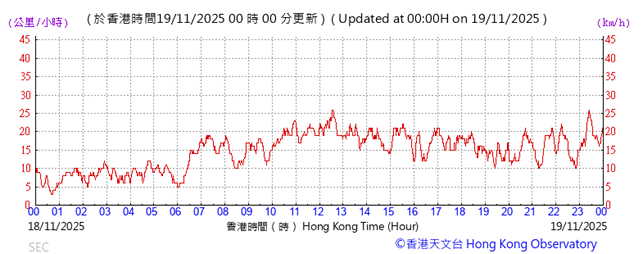


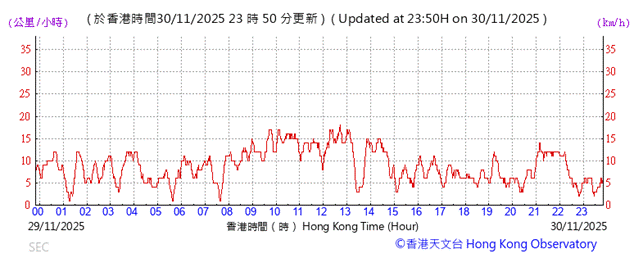
Appendix
K
Calibration
Certificates for Noise Monitoring Equipment
Appendix
L
Noise
Monitoring Results and their Graphical Presentations
Appendix
M
Waste Flow Table
Appendix N
Statistics on Complaint, Notifications of Summons and
Successful Prosecution
Statistical Summary of Environmental Complaints
|
Reporting Period
|
Environmental Complaint Statistics
|
|
Frequency
|
Cumulative
|
Complaint Nature
|
|
1 November 2025
-
30 November 2025
|
0
|
0
|
N/A
|
Statistical Summary of Environmental Non-compliance
|
Reporting Period
|
Environmental Non-compliance Statistics
|
|
Frequency
|
Cumulative
|
Details
|
|
1 November 2025
-
30 November 2025
|
0
|
0
|
N/A
|
Statistical Summary of Environmental Summons
|
Reporting Period
|
Environmental Summons Statistics
|
|
Frequency
|
Cumulative
|
Details
|
|
1 November 2025
-
30 November 2025
|
0
|
0
|
N/A
|
Statistical Summary of Environmental Prosecution
|
Reporting Period
|
Environmental Prosecution Statistics
|
|
Frequency
|
Cumulative
|
Details
|
|
1 November 2025
-
30 November 2025
|
0
|
0
|
N/A
|